Digital Omnibus evidence planning
EU AI Act Standards Readiness After the Omnibus
Regulation (EU) 2026/1744 sets later high-risk application dates partly so technical standards and support tools can mature. Do not use that window as a waiting room. Use it to build evidence structures that can absorb harmonised standards, common specifications, and final guidance when they arrive.
Educational planning guide only. Not legal advice. Not a compliance guarantee. Regulation (EU) 2026/1744 is in force. Use the consolidated Regulation (EU) 2024/1689 and keep voluntary standards distinct from legal obligations.
Quick answer
Standards are not final, but evidence work should not wait.
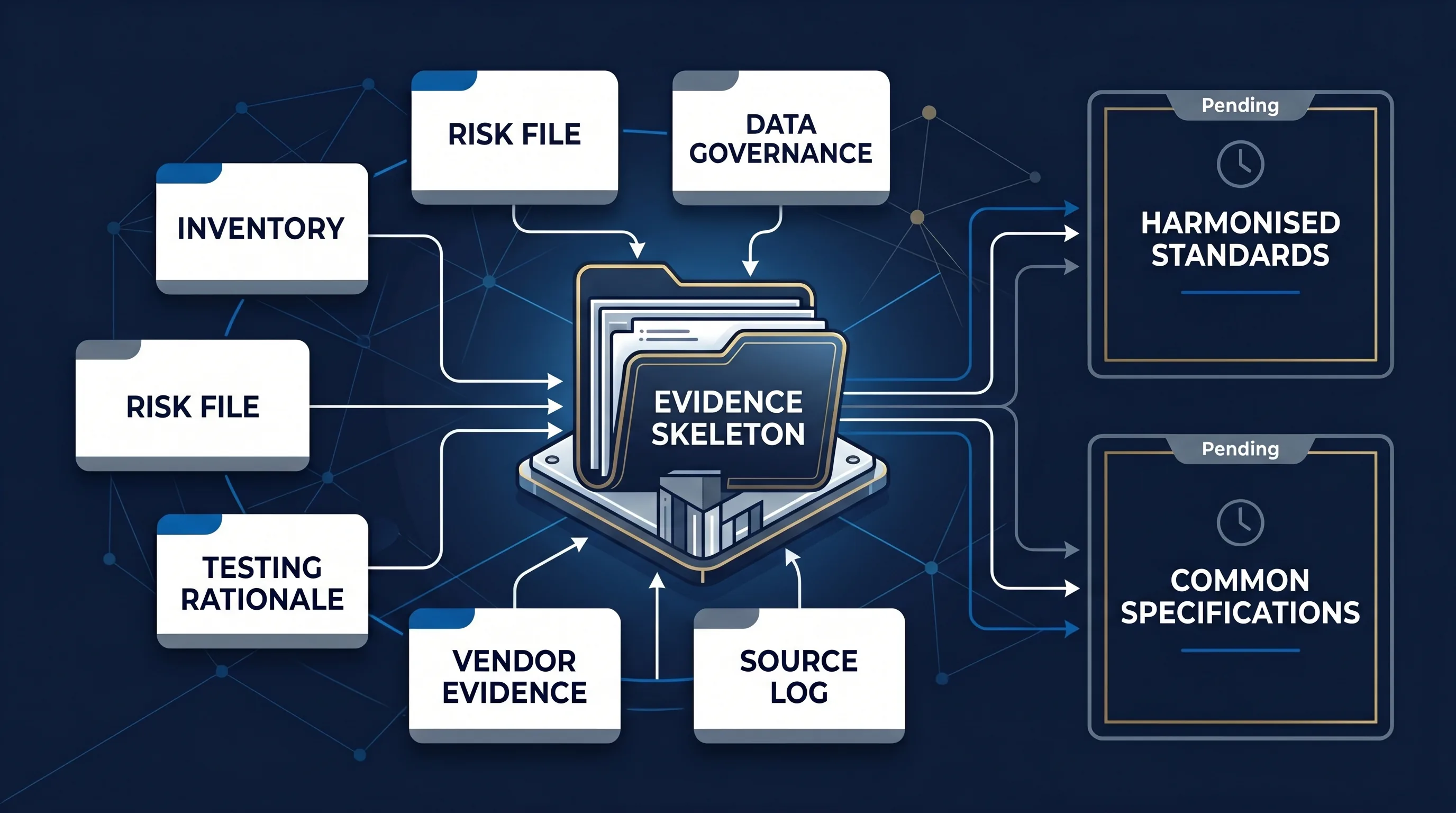
Standards readiness is the practice of preparing a stable evidence file before final harmonised standards, common specifications, or detailed guidance are available. For AI governance teams, the stable work is inventory, role classification, risk route, data governance, testing rationale, oversight design, logging, vendor evidence, and a dated source-review log.
The page does not claim that a checklist proves conformity. It gives operators a practical preparation route while harmonised standards, common specifications, and sector-specific guidance continue to evolve.
Regulatory logic
Why standards readiness matters after the Omnibus
The Commission says the later high-risk timing will help ensure technical standards and support tools are in place before rules start to apply.
AI Act Article 40 links harmonised standards to a presumption of conformity when references are published in the Official Journal.
Article 41 allows common specifications where harmonised standards are unavailable, late, incomplete, or insufficient for the relevant requirements.
Decision table
What to prepare before final standards land
| Evidence area | Why it remains useful | Owner to assign |
|---|---|---|
| AI inventory | Routes the system to role, risk, Article 50, product, vendor, and oversight checks. | AI governance owner or compliance lead |
| Risk management file | Future standards are likely to test whether risks are identified, evaluated, controlled, and reviewed. | Provider product owner or risk manager |
| Data governance note | Data quality, representativeness, limitations, and use constraints remain central for high-risk AI evidence. | Data owner or model owner |
| Testing rationale | Accuracy, robustness, cybersecurity, and oversight claims need test logic before final thresholds are known. | Engineering, security, and model validation |
| Vendor evidence request | Deployers need supplier evidence even when final standards mapping is still moving. | Procurement, legal, compliance, or security |
| Source-review log | Shows whether a decision relied on consolidated law, draft or final guidance, cited standards, or common specifications. | AI governance owner |
Standards-readiness checklist
Build the file in three passes
Pass 1
Stabilise the system record
- Name the AI system and owner.
- Record provider, deployer, product, importer, or distributor role assumptions.
- Map intended purpose, users, data categories, and vendor involvement.
- Record the consolidated-law route and provision-specific application date.
Pass 2
Prepare the evidence skeleton
- Create risk management, data governance, technical documentation, logging, oversight, and testing placeholders.
- Add vendor evidence questions where a third-party system is used.
- Link Article 50, prohibited-practice, and product-integration triggers where relevant.
- Keep missing records visible in a gap register.
Pass 3
Map official standards later
- Track harmonised standards published in the Official Journal.
- Track common specifications if they are adopted.
- Update control wording and test criteria when source material becomes final.
- Keep the before-and-after source review note.
Do now
Records to create this week
- One-page standards-readiness note: system, role, track, source basis, and owner.
- Evidence map: requirement area, current file, missing file, owner, due date.
- Vendor request: current documentation, roadmap assumptions, standardisation watch owner, and change-notice channel.
- Decision log: what the team decided before final standards were available and why.
Do not do
Claims to avoid
- Do not say the organisation is compliant because it has a standards-readiness checklist.
- Do not treat draft standards, informal commentary, or vendor roadmaps as final law.
- Do not collapse Article 50, prohibited-practice, GPAI, product, and high-risk evidence into one generic AI policy.
- Do not wait for standards before assigning owners and creating the evidence skeleton.
Related tools and guides
Open the next record
Digital Omnibus cluster
Use the cluster in the right order.
Start with the router, then open the guide that matches the planning track: standards readiness, product-integrated AI, or SME and small-mid-cap relief.
Omnibus Deadline Router
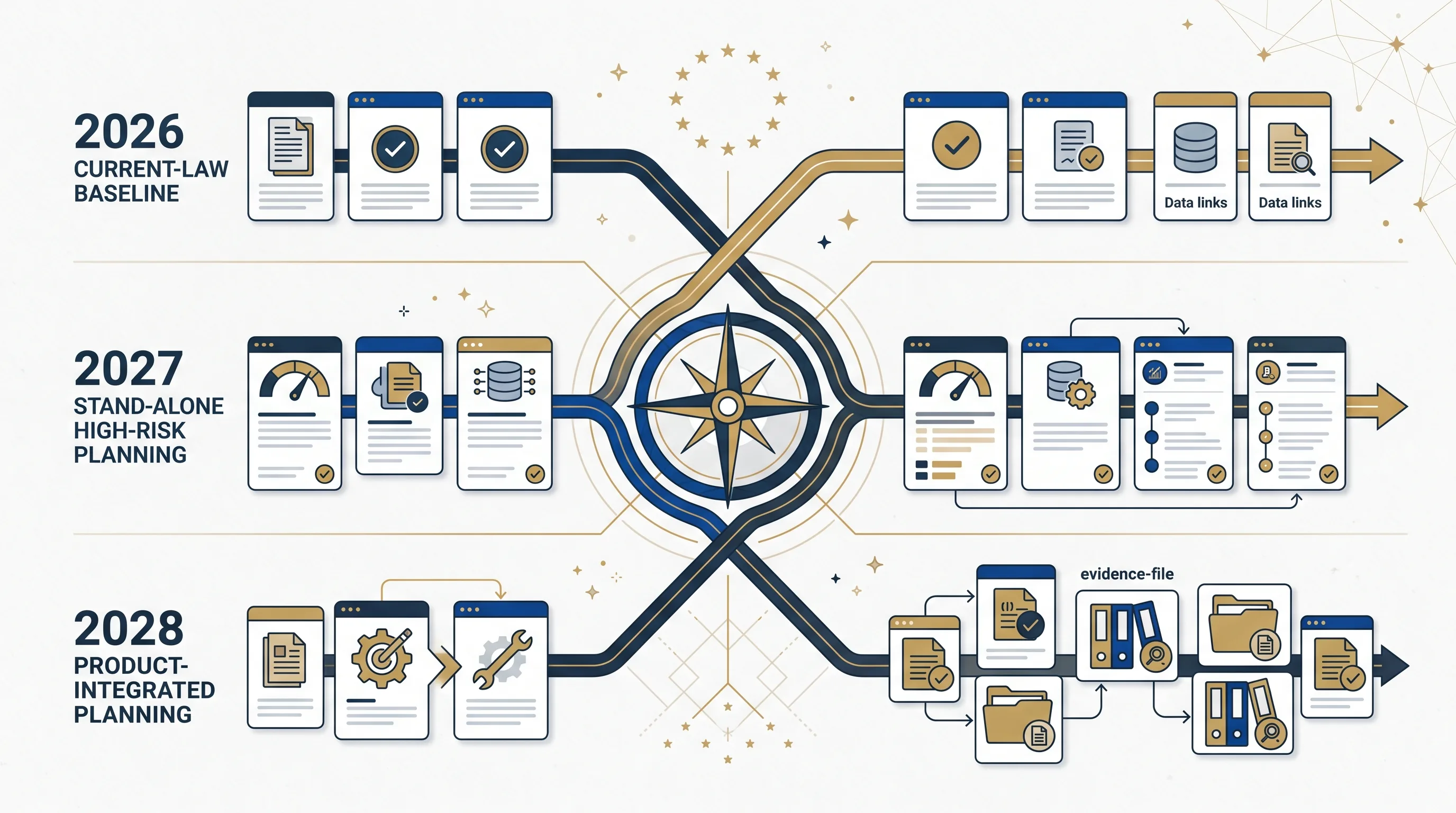
Separate current-law dates from 2026, 2027, and 2028 planning tracks for one AI system.
GUIDE · 5 MIN · CURRENT PAGEStandards Readiness After the Omnibus
Build evidence structures that can absorb harmonised standards and common specifications when they arrive.
GUIDE · 5 MINProduct-Integrated AI Systems and 2028
Connect AI Act planning with the product safety file, supplier evidence, and sectoral-law overlap.
GUIDE · 5 MINSmall Mid-Cap Relief After the Omnibus
Treat SME and small-mid-cap relief as a planning issue, not an exemption from records.
FAQ