Digital Omnibus sector guide
EU AI Act Product-Integrated AI Systems and the 2028 Timeline
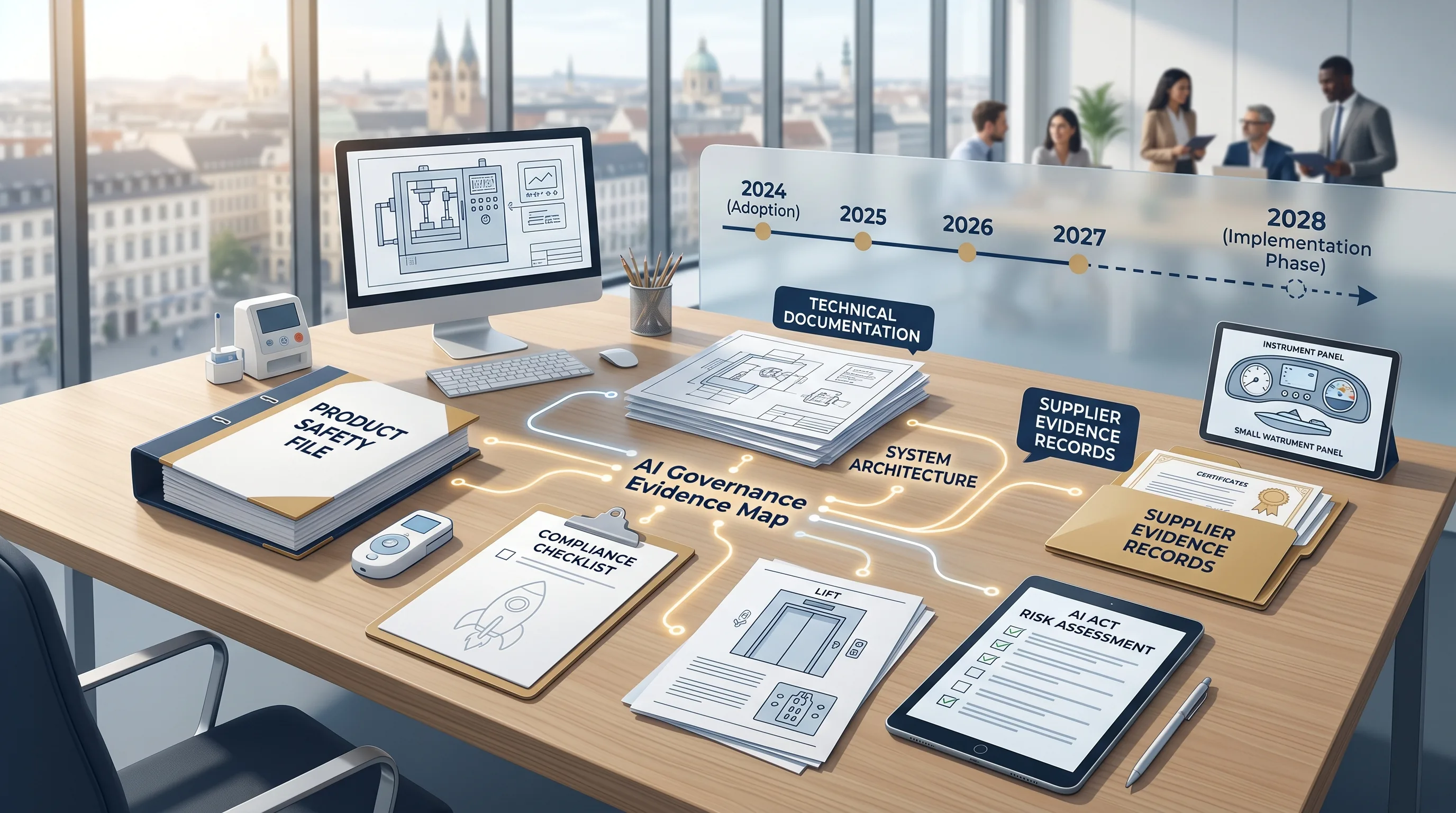
If AI is embedded inside a regulated product, Regulation (EU) 2026/1744 sets 2 August 2028 as the application date for the Article 6(1) / Annex I product-integrated high-risk route. The practical issue is not only the date. It is how the product safety file, supplier evidence, technical documentation, and EU AI Act evidence plan fit together.
Educational planning guide only. Not legal advice. Not a compliance guarantee. Regulation (EU) 2026/1744 is in force. The relevant Article 6(1)/Annex I high-risk provisions apply from 2 August 2028 under the consolidated AI Act.
Quick answer
The 2028 track is a planning route for AI embedded in regulated products.
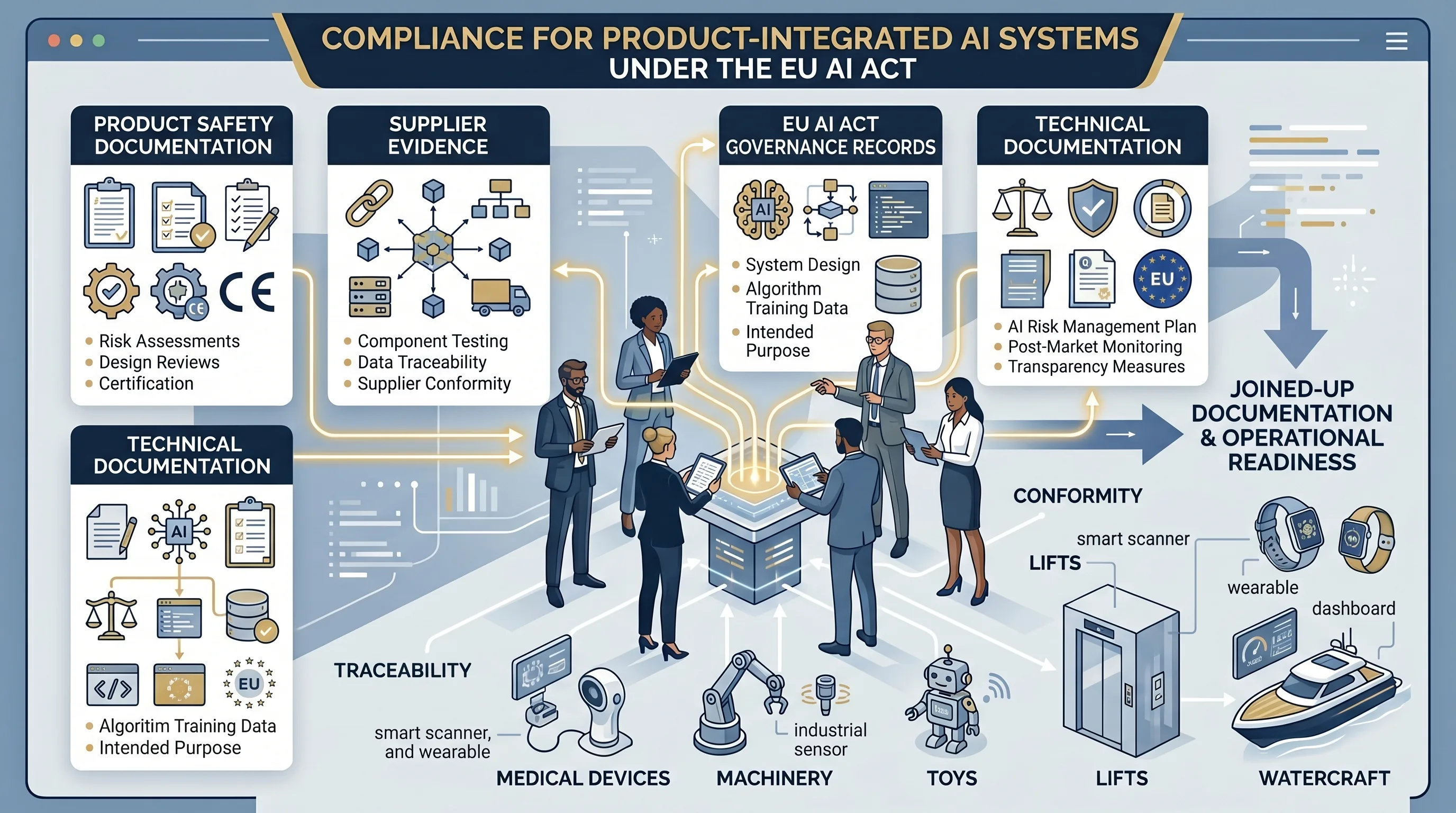
Regulation (EU) 2026/1744 is in force and sets 2 August 2028 as the application date for Article 6(1) / Annex I product-integrated high-risk systems. Product-sector rules still require route-specific review, including for medical devices, toys, lifts, machinery and watercraft.
So the real preparation task is to connect AI Act planning with the product safety route, the supplier evidence trail, and the technical file. Waiting for the final date without building the evidence map creates avoidable documentation debt.
Regulatory logic
What the official summaries say
Regulation (EU) 2026/1744 sets 2 August 2028 as the application date for Article 6(1) / Annex I product-integrated high-risk systems.
Council highlights medical devices, toys, lifts, machinery, and watercraft as sectors where overlap with sectoral legislation needed a compromise mechanism.
Regulation (EU) 2026/1744 adds a Commission guidance obligation to help economic operators minimise compliance burden for these product-linked high-risk systems.
Decision table
What teams should separate clearly
| Question | What to do | What not to assume |
|---|---|---|
| Is the AI function embedded in a regulated product? | Map the product type, product law route, AI function, and named owner. | Do not assume a general software-only route applies. |
| Which file will carry the evidence? | Connect the technical file, product safety documentation, supplier record, and AI Act note. | Do not leave AI evidence isolated from product documentation. |
| Is there sectoral overlap? | Record which sectoral requirements may cover similar AI-specific issues. | Do not assume overlap removes all AI Act work automatically. |
| What should be requested from suppliers? | Ask for intended purpose, instructions for use, testing summary, monitoring information, and change control. | Do not accept a generic marketing brochure as evidence. |
Product-integrated checklist
Build the product AI evidence route in four steps
Step 1
Identify the product lane
- Name the product and AI function.
- Record the product law route and product owner.
- Record whether the AI function appears safety relevant.
- Separate currently applicable duties from future statutory application dates.
Step 2
Join the files
- Create a bridge between the technical file and AI Act evidence note.
- Link risk management, testing, logging, and change control.
- Record supplier dependencies and open evidence gaps.
- Assign owners for updates.
Step 3
Ask better supplier questions
- Request intended purpose and system boundaries.
- Request instructions for use and limitations.
- Request testing and monitoring evidence.
- Request change notices and version control process.
Step 4
Keep a source log
- Log the source used for each planning assumption.
- Record the consolidated current law and the route-specific application date.
- Update when guidance or standards arrive.
- Keep the decision owner and date visible.
Related EU AI Compass routes
Open the next tool or guide
Route one AI system to the relevant statutory application date.
Conformity Assessment ChecklistReview documentation and assessment steps for high-risk routes.
Technical Documentation TemplateStructure the technical file and evidence owners.
IIoT Safety ValidatorStress test safety and risk assumptions in industrial AI contexts.
Digital Omnibus cluster
Use the cluster in the right order.
Start with the router, then open the guide that matches the application-date route: standards readiness, product-integrated AI, or SME and small-mid-cap relief.
Omnibus Deadline Router
Separate currently applicable duties from the 2026, 2027, and 2028 statutory application dates for one AI system.
GUIDE · 5 MINStandards Readiness After the Omnibus
Build evidence structures that can absorb harmonised standards and common specifications when they arrive.
GUIDE · 5 MIN · CURRENT PAGEProduct-Integrated AI Systems and 2028
Connect AI Act planning with the product safety file, supplier evidence, and sectoral-law overlap.
GUIDE · 5 MINSmall Mid-Cap Relief After the Omnibus
Treat SME and small-mid-cap relief as a planning issue, not an exemption from records.
FAQ