Quick answer
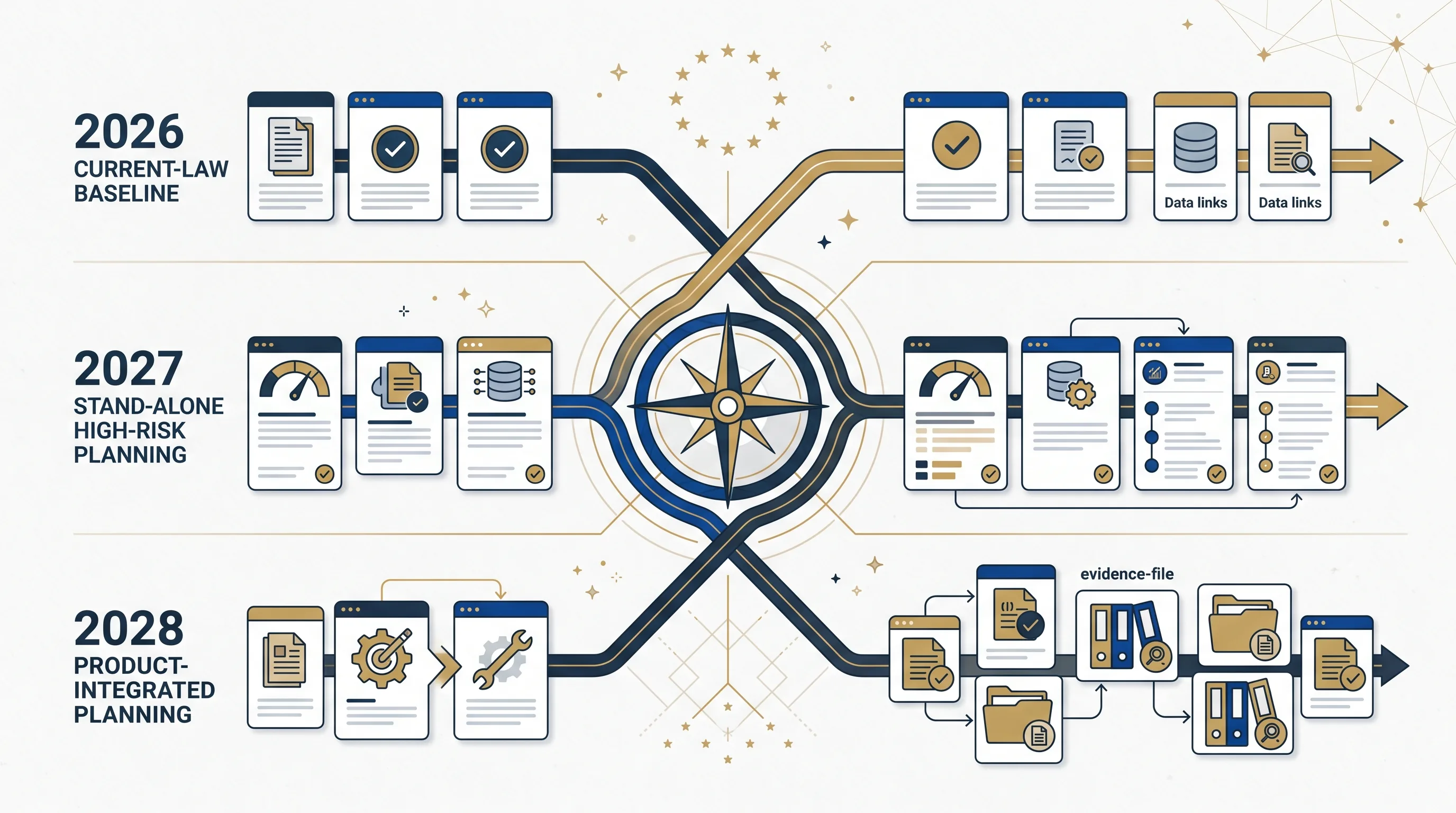
Regulation (EU) 2026/1744 is in force. It moves Article 6(2) / Annex III high-risk AI obligations to 2 December 2027 and Article 6(1) / Annex I product-integrated high-risk AI rules to 2 August 2028. Use the consolidated Regulation (EU) 2024/1689, current from 27 July 2026, as the legal baseline.
Need to know which track applies?
Use the Omnibus Deadline Router to identify the applicable 2026, 2027 or 2028 route for one AI system.
Run the Omnibus Deadline Router →Digital Omnibus update, 30 June 2026
The Council adopted the Digital Omnibus on AI on 29 June 2026. Regulation (EU) 2026/1744 was published on 24 July 2026 and entered into force on 27 July 2026. It sets 2 December 2027 for Article 6(2) / Annex III systems and 2 August 2028 for Article 6(1) / Annex I product-integrated systems.
What Regulation (EU) 2026/1744 changed
The co-legislators agreed and adopted the Digital Omnibus before Regulation (EU) 2026/1744 was published on 24 July 2026. It entered into force on 27 July 2026. Council materials record legislative history; EUR-Lex and the consolidated AI Act control current legal status.
That distinction has to be visible on the website because many deployer teams will read the news as permission to stop. That would be a weak control decision.
| Planning item | Current legal position | Application date | EU AI Compass action |
|---|---|---|---|
| Certain Annex III high-risk AI systems | Regulation (EU) 2026/1744 amended the Article 6(2) / Annex III route. | These requirements apply from 2 December 2027. | Classify the system and keep evidence work active. |
| High-risk AI integrated into products | Regulation (EU) 2026/1744 amended the Article 6(1) / Annex I route. | These requirements apply from 2 August 2028. | Map the product-safety overlap and use the route-specific date. |
| Article 50 transparency | Article 50 generally applies from 2 August 2026. | Article 111(4) provides only a narrow Article 50(2) legacy-system transition to 2 December 2026. | Review Article 50 pages separately and do not assume all transparency duties moved to 2027. |
| SME and deployer evidence work | Inventory, vendor evidence, oversight, logs, and disclosure records remain useful. | Route-specific dates change sequencing, not the need for evidence. | Route users to the deadline tracker and evidence checklist. |
What deployers should keep doing
- Inventory AI systems: capture owner, vendor, purpose, user group, data categories, and lifecycle status.
- Separate role and risk assumptions: record why the organisation is acting as a deployer, provider, importer, distributor, or product manufacturer.
- Ask vendors for evidence: retain instructions for use, technical documentation extracts, oversight information, data governance summaries, and update notices.
- Review Article 50 triggers: chatbot, synthetic content, deepfake, emotion-recognition, and biometric-categorisation notices still need operational routing.
- Maintain a status log: record whether a decision relied on binding consolidated law, a future statutory application date, draft guidance, or final guidance.
What still requires provision-specific review
Write internal policy against the consolidated AI Act. Do not treat 2 August 2026 as a universal high-risk date or treat the later high-risk dates as a reason to pause. Sequence the evidence programme against the applicable provision-specific route.
Open the master timeline
See the consolidated law and route-specific application dates in one place.
Compare legal-status tracks
Use the consolidated-law and route-specific-date view.
Digital Omnibus cluster
Use the cluster in the right order.
Start with the router, then open the guide that matches the planning track: standards readiness, product-integrated AI, or SME and small-mid-cap relief.
Omnibus Deadline Router
Separate the current consolidated baseline from the 2026, 2027, and 2028 application routes for one AI system.
GUIDE · 5 MINStandards Readiness After the Omnibus
Build evidence structures that can absorb harmonised standards and common specifications when they arrive.
GUIDE · 5 MINProduct-Integrated AI Systems and 2028
Connect AI Act planning with the product safety file, supplier evidence, and sectoral-law overlap.
GUIDE · 5 MINSmall Mid-Cap Relief After the Omnibus
Treat SME and small-mid-cap relief as a planning issue, not an exemption from records.
Frequently asked questions
Is the EU AI Act Digital Omnibus now law?
Yes. Regulation (EU) 2026/1744 was published on 24 July 2026 and entered into force on 27 July 2026. Use the consolidated AI Act and the applicable provision-specific date.
What changes for high-risk AI systems?
Regulation (EU) 2026/1744 sets Article 6(2) / Annex III high-risk requirements to apply from 2 December 2027. The affected planning track includes high-risk systems such as biometric, education, employment, critical infrastructure, migration, asylum, border control, law enforcement, and related Annex III use cases.
What changes for product-integrated high-risk AI systems?
Regulation (EU) 2026/1744 sets Article 6(1) / Annex I product-integrated requirements to apply from 2 August 2028. Product teams should still map the AI system, sectoral safety rules, conformity route, vendor evidence, and owner before treating the later date as usable planning time.
Should deployers pause evidence work because some application dates are later?
No. Deployers should not pause evidence work. A safer approach is to split the file by provision-specific route and retain evidence that will be useful before each application date: inventory, vendor records, oversight notes, user instructions, logs, and Article 50 checks.
What should EU AI Compass users do next?
Use the amended AI Act timeline as a planning control, not a reason to wait. Start with the timeline page, check whether the AI system could be high-risk, and keep a dated evidence file showing the regulatory status used for each internal decision.
Last evidence review date: 2 September 2026
Source basis: Regulation (EU) 2024/1689 as amended by Regulation (EU) 2026/1744 is the current legal baseline. The consolidated text is current from 27 July 2026. This page is for operational planning and is not legal advice.
Consolidated Regulation (EU) 2024/1689 · Regulation (EU) 2026/1744 · Council adoption history · Council 7 May 2026 agreement press release
Keep the evidence work moving
Regulation (EU) 2026/1744 changed the timeline, but it does not remove the need to know which AI systems exist, who owns them, which vendor records support them, and what evidence a deployer can show.