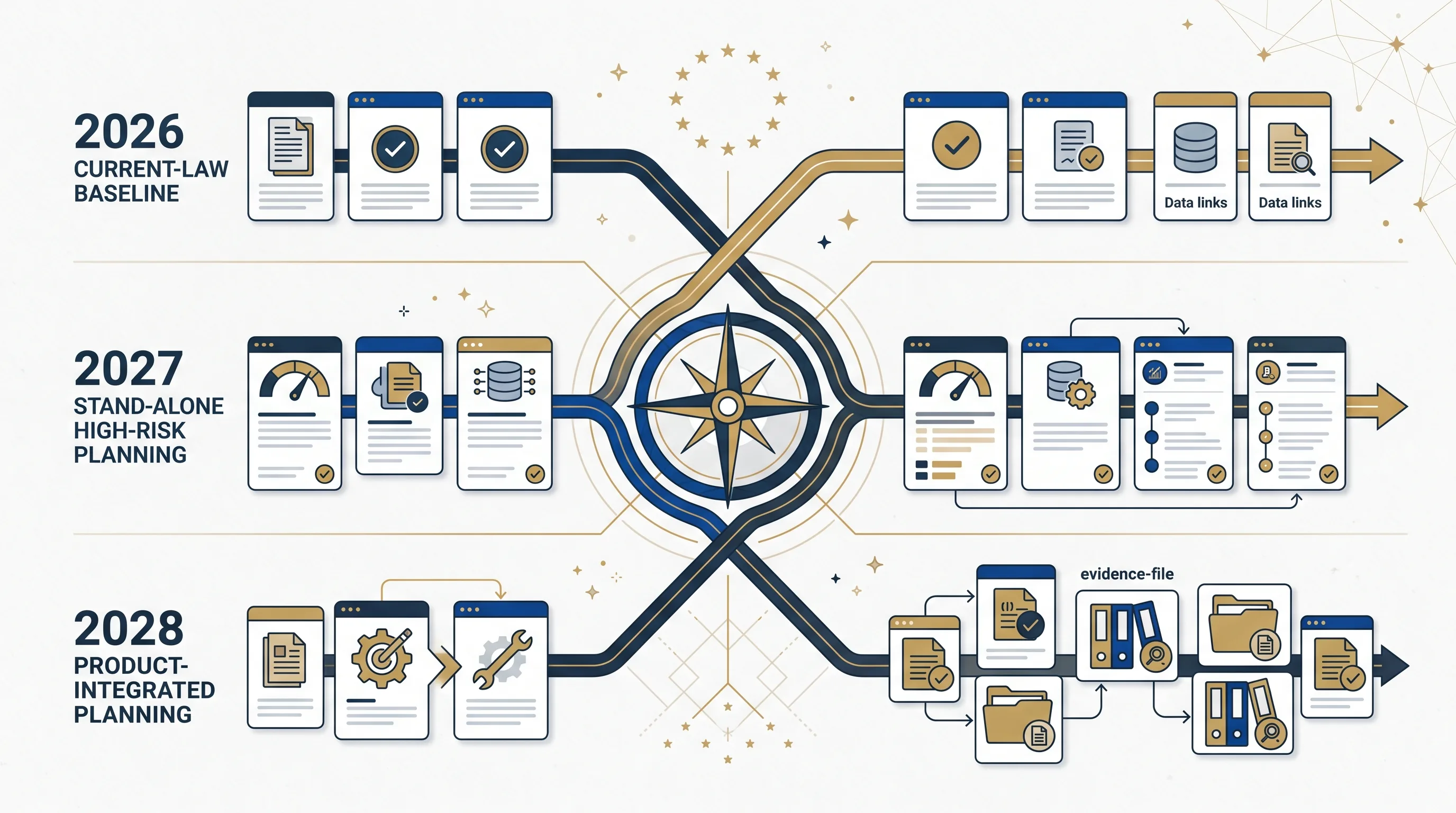
How to read this page: “Current law” means Regulation (EU) 2024/1689 as amended and consolidated from 27 July 2026. Application dates remain provision-specific: entry into force does not make every later obligation immediately applicable.
Key dates at a glance
| Date | Track | What it means | Planning action |
|---|---|---|---|
| 1 August 2024 | Existing Regulation (EU) 2024/1689 baseline | The EU AI Act became law and the phased timeline started. | Use this as the starting point. |
| 2 February 2025 | Existing Regulation (EU) 2024/1689 baseline | Prohibited practices and AI literacy duties became live. | Keep screening records and training evidence. |
| 2 August 2025 | Existing Regulation (EU) 2024/1689 baseline | GPAI, governance, notified-body, and penalty rules became live. | Keep GPAI and vendor records where relevant. |
| 2 August 2026 | Existing Regulation (EU) 2024/1689 baseline | Article 50 and most remaining provisions generally apply from this date, subject to provision-specific exceptions; Article 6(2) / Annex III moved to 2 December 2027. | Use this date for obligations that apply here and verify Article 50 and high-risk routes separately. |
| 2 December 2026 | Current statutory date | The narrow Article 50(2) legacy-system transition ends; the specified new Article 5 provisions also apply from this date. | Review Article 50 separately. Do not assume every transparency duty moves to 2027. |
| 2 December 2027 | Current statutory date | Article 6(2) / Annex III high-risk requirements apply from this date under Regulation (EU) 2026/1744. | Continue classification and evidence work before application. |
| 2 August 2028 | Current statutory date | Article 6(1) / Annex I product-integrated high-risk requirements apply from this date under Regulation (EU) 2026/1744. | Map the product-safety overlap and verify the applicable product regime. |
What to keep preparing
| Area | Current law | Route-specific status | What to keep |
|---|---|---|---|
| AI literacy and prohibited-practices screening | Already live from 2 February 2025. | No later route date identified here. | Keep training records, role exposure notes, policy acknowledgements, and prohibited-practices screening. |
| GPAI and governance framework provisions | Already live from 2 August 2025 for relevant operators. | No later route date identified here. | Keep vendor records, model information, downstream-use limits, and update notices where relevant. |
| Annex III Article 6(2) high-risk AI obligations | 2 December 2027 under Regulation (EU) 2026/1744. | Regulation (EU) 2026/1744 sets 2 December 2027 for Article 6(2)/Annex III high-risk AI systems, under Regulation (EU) 2026/1744. | Keep inventory, risk rationale, instructions for use, oversight records, logs, and vendor evidence. |
| Article 50 transparency | Article 50 generally applied from 2 August 2026, subject to route-specific exceptions. | A narrow Article 50(2) legacy-system transition ends on 2 December 2026; Article 50(4) is not included. | Keep notices, labelling decisions, synthetic-content workflow records, and disclosure approvals. |
| Article 6(1)/Annex I product-integrated high-risk AI systems | 2 August 2028 under Regulation (EU) 2026/1744. | Regulation (EU) 2026/1744 sets 2 August 2028 for Article 6(1)/Annex I systems, under Regulation (EU) 2026/1744. | Map the product regime, AI safety-component role, manufacturer duties, and conformity route. |
Detailed timeline
1 August 2024
EU AI Act enters into force
The AI Act entered into force. This started the phased implementation clock but did not make every later obligation immediately applicable.
Existing Regulation (EU) 2024/1689 baseline, Article 113
2 February 2025
Prohibited practices and AI literacy apply
AI literacy and prohibited-practices obligations are already live under the existing AI Act baseline. Organisations should keep training and screening records rather than waiting for later timeline changes.
Articles 4 and 5
2 August 2025
GPAI and governance provisions apply
GPAI, governance, notified-body, and penalty-framework provisions are part of the already-applicable track for relevant operators.
Existing Regulation (EU) 2024/1689 baseline
2 August 2026
General application milestone
Article 50 and most remaining provisions generally apply from 2 August 2026, subject to provision-specific exceptions. Regulation (EU) 2026/1744 moved Article 6(2) / Annex III and Article 6(1) / Annex I high-risk routes to later dates.
Regulation (EU) 2024/1689 as amended
2 August 2027
AI regulatory sandbox milestone
Member States must ensure that at least one AI regulatory sandbox is operational by 2 August 2027. Verify national implementation and access routes.
Regulation (EU) 2026/1744, Article 57
2 December 2027
Article 6(2) / Annex III application date
The Article 6(2) / Annex III high-risk requirements apply from this date under Regulation (EU) 2026/1744.
Regulation (EU) 2026/1744
2 August 2028
Article 6(1) / Annex I application date
The Article 6(1) / Annex I product-integrated high-risk requirements apply from this date under Regulation (EU) 2026/1744.
Regulation (EU) 2026/1744
Frequently asked questions
What are the current EU AI Act dates?
The EU AI Act entered into force on 1 August 2024 and applies in phases. Regulation (EU) 2026/1744 sets 2 December 2027 for the relevant Article 6(2)/Annex III high-risk provisions and 2 August 2028 for Article 6(1)/Annex I product-integrated high-risk provisions. Article 50 and other obligations must be checked separately.
What changed under Regulation (EU) 2026/1744?
Regulation (EU) 2026/1744 was published on 24 July 2026 and entered into force on 27 July 2026. Regulation (EU) 2026/1744 changes parts of the timeline. This page separates current law by provision-specific application date.
Why does the timeline now include 2028?
The timeline includes 2028 because Regulation (EU) 2026/1744 sets 2 August 2028 for Article 6(1)/Annex I product-integrated high-risk AI systems. Product and safety teams still need to map sectoral-law overlap and evidence duties.
Which high-risk AI systems have later application dates under Regulation (EU) 2026/1744?
Regulation (EU) 2026/1744 sets 2 December 2027 for Article 6(2)/Annex III systems and 2 August 2028 for Article 6(1)/Annex I systems. Use case classification still needs case-by-case review.
Should deployers keep preparing evidence?
Yes. Inventory, vendor due diligence, human oversight, logs, user instructions, Article 50 notices, and ownership records remain useful under both tracks. The later date does not remove the evidence gap.
Related resources
Last evidence review date: 2 September 2026
Source basis: Regulation (EU) 2024/1689 as amended by Regulation (EU) 2026/1744 is the current legal baseline. The consolidated text is current from 27 July 2026. This page is for operational planning and is not legal advice.
Consolidated Regulation (EU) 2024/1689 · Regulation (EU) 2026/1744 · Council adoption history · Council 7 May 2026 agreement press release
Keep the evidence work moving
Regulation (EU) 2026/1744 changed the timeline, but it does not remove the need to know which AI systems exist, who owns them, which vendor records support them, and what evidence a deployer can show.