Digital Omnibus SME and SMC guide
EU AI Act Small Mid-Cap Relief After the Omnibus
Regulation (EU) 2026/1744 extends specified SME measures to small mid-cap enterprises where its conditions apply, but it does not create a no-evidence card. Smaller organisations still need an AI inventory, role decision, vendor trail, transparency trigger note, and dated source log.
Educational planning guide only. Not legal advice. Not a company-size determination. Regulation (EU) 2026/1744 is in force. Use the consolidated Regulation (EU) 2024/1689 and verify the applicable SMC definition, measure and date.

Quick answer
Small mid-cap relief is a planning category, not an exemption from evidence.
Regulation (EU) 2026/1744 extends specified SME measures to small mid-caps in limited provisions. That is materially different from saying SMEs or small mid-caps can pause EU AI Act readiness.
Keep a lean evidence file and use the consolidated AI Act to verify the exact relief measure, eligibility conditions and application date. The Regulation was published on 24 July 2026 and entered into force on 27 July 2026.
Regulatory logic
What the official sources support
Regulation (EU) 2026/1744 was published on 24 July 2026 and entered into force on 27 July 2026. Check the consolidated AI Act and the exact relief provision before relying on it.
Regulation (EU) 2026/1744 extends specified SME measures to small mid-caps in limited provisions, subject to the legal conditions.
The Commission's wider simplification note describes small-mid caps as companies below 750 employees and within stated turnover or asset thresholds.
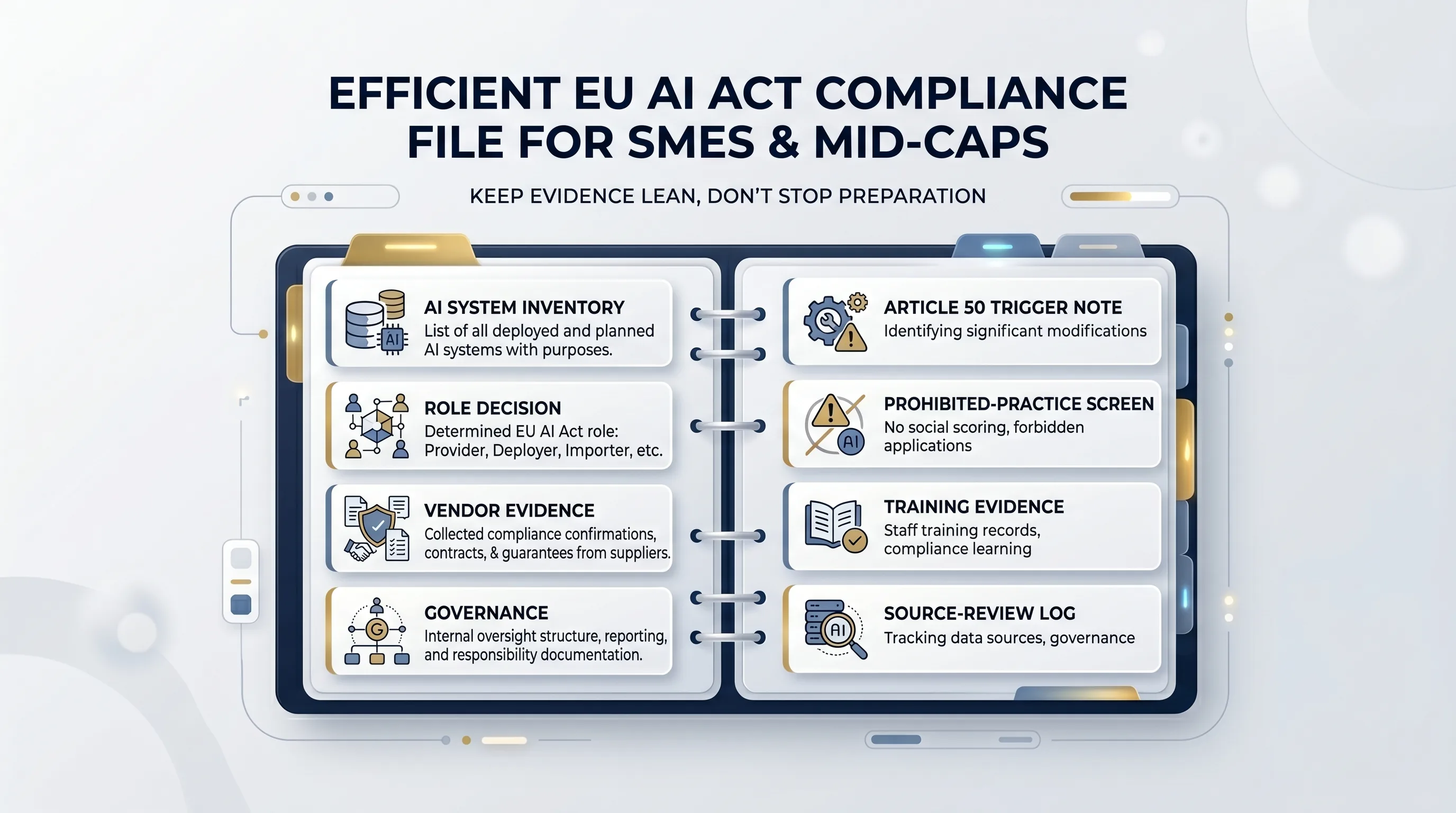
Decision table
What smaller organisations should separate clearly
| Question | Conservative planning answer | Evidence to keep |
|---|---|---|
| Does relief mean exemption? | No. Treat relief as a proportionality and simplification question until final text confirms the scope. | Relief assumption note and source-review log. |
| Does the company size matter? | Yes, but company-size status must be checked carefully, especially where group structure or linked enterprises matter. | Company-size basis and owner for legal or finance review. |
| Can AI inventory wait? | No. Inventory is the cheapest control to start and the easiest one to keep updated. | System name, owner, vendor, purpose, users, data, trigger flags. |
| Can vendor evidence wait? | No. Third-party AI features can create obligations before an internal team fully understands the system. | Vendor questions, supplier answers, follow-up owner, unresolved gaps. |
Relief-readiness checklist
Build a lean evidence file in four steps
Step 1
Map the company basis
- Record SME or SMC assumption.
- Record employee, turnover, and asset basis if available.
- Flag group-structure uncertainty.
- Assign finance or counsel review owner.
Step 2
Keep the AI inventory alive
- Name each AI system or AI-enabled feature.
- Record owner, purpose, user group, and vendor.
- Mark high-risk, Article 50, and prohibited-practice signals.
- Log changes as the system evolves.
Step 3
Ask minimum vendor questions
- Request intended purpose and instructions for use.
- Request transparency and content marking information.
- Request high-risk and product-integration position.
- Record gaps and follow-up owners.
Step 4
Preserve the source note
- State the current consolidated-law baseline.
- Record the exact relief provision and eligibility assumption.
- Update the record when facts, guidance or law change.
- Keep the decision owner visible.
Related EU AI Compass routes
Open the next tool or guide
Route one AI system into the likely planning track.
SME Deadline GuideSeparate provisions already applicable from future statutory application dates.
AI System Inventory TemplateStart the smallest practical evidence record.
Vendor Evidence Request BuilderAsk supplier questions before enabling or expanding AI features.
Digital Omnibus cluster
Use the cluster in the right order.
Start with the router, then open the guide that matches the planning track: standards readiness, product-integrated AI, or SME and small-mid-cap relief.
Omnibus Deadline Router
Separate current-law dates from 2026, 2027, and 2028 planning tracks for one AI system.
GUIDE · 5 MINStandards Readiness After the Omnibus
Build evidence structures that can absorb harmonised standards and common specifications when they arrive.
GUIDE · 5 MINProduct-Integrated AI Systems and 2028
Connect AI Act planning with the product safety file, supplier evidence, and sectoral-law overlap.
GUIDE · 5 MIN · CURRENT PAGESmall Mid-Cap Relief After the Omnibus
Treat SME and small-mid-cap relief as a planning issue, not an exemption from records.
FAQ