Quick answer
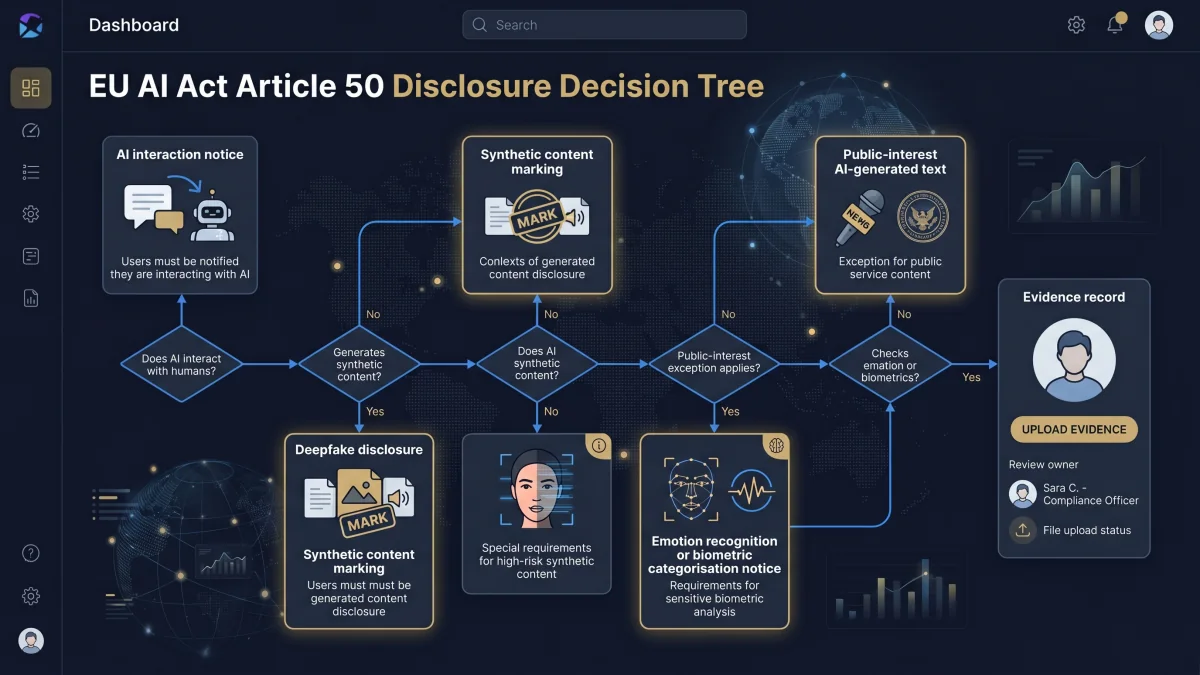
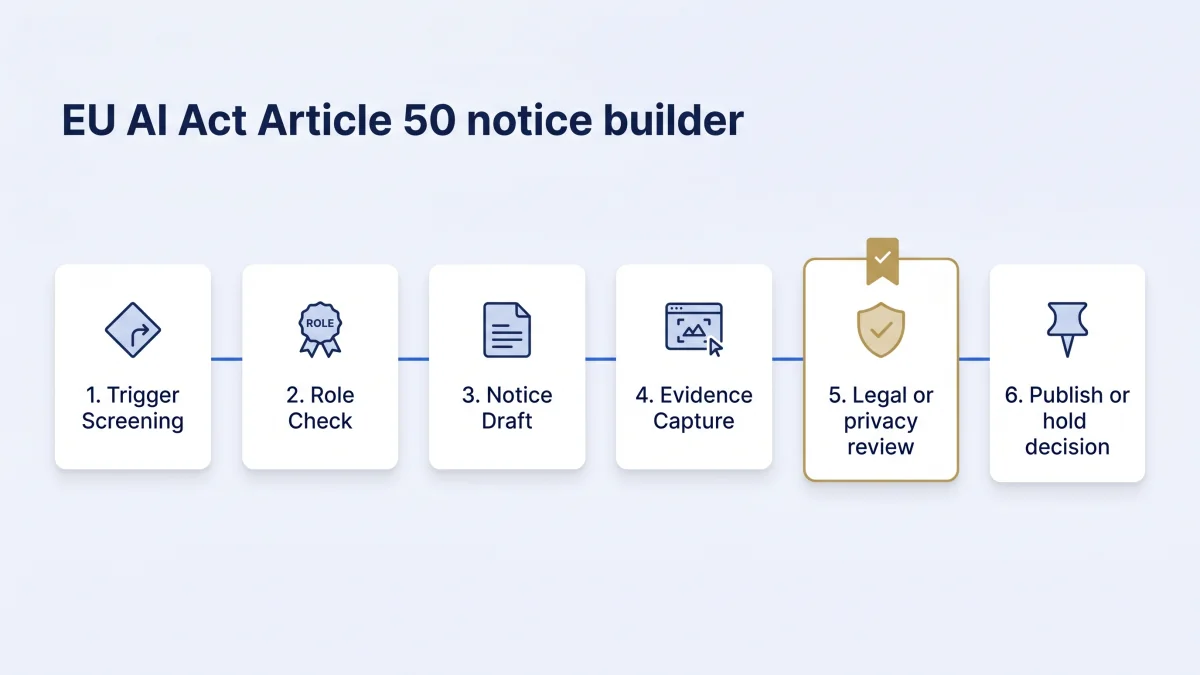
EU AI Act Article 50 disclosure work starts by identifying the transparency scenario: direct AI interaction, synthetic content marking, emotion recognition or biometric categorisation, deepfake disclosure, or public-interest AI-generated text. This local-only tool turns those inputs into conservative draft notices, evidence records, and escalation notes for legal, privacy, product, accessibility, or communications review.
Current-law planning note
Article 50 contains transparency obligations for providers and deployers of certain AI systems, and the AI Act Service Desk states that Article 50 transparency requirements apply as of 2 August 2026. Use this page as an operational screening aid only. The European Commission published the Code of Practice on marking and labelling AI-generated content on 10 June 2026. Treat the Code as voluntary implementation support for marking and labelling workflows, not as a substitute for Article 50, Commission guidelines, or qualified legal review.
Run the Article 50 decision tree
Local-only builder
Screen the transparency trigger and draft the notice
Use a working name and select the scenario. The output is generated in this browser. Do not enter personal data, client content, prompts, logs, model outputs, credentials, trade secrets, or sensitive system details.
Output appears here
Run the decision tree to generate scenario tags, draft notice copy, evidence records, and escalation notes.
Article 50 trigger map
| Scenario | Operational question | Typical output |
|---|---|---|
| Direct AI interaction | Will a natural person interact directly with the AI system? | AI interaction notice or rationale if obvious in context. |
| Synthetic content | Does the system generate synthetic audio, image, video, or text? | Provider marking request and deployer publication check. |
| Emotion / biometric | Are people exposed to emotion recognition or biometric categorisation? | Notice plus privacy/legal escalation. |
| Deepfake | Could AI-generated or manipulated image, audio, or video falsely appear authentic? | Disclosure notice plus communications/legal review. |
| Public-interest text | Is AI-generated or manipulated text published to inform the public on matters of public interest? | Disclosure review, editorial-control check, and retained evidence. |
Provider vs deployer split
The Article 50 provider/deployer split matters because provider-side marking and deployer-side notice work are different evidence tasks. A provider may need to support machine-readable marking and detectability for synthetic outputs. A deployer may need to disclose deepfakes, public-interest AI-generated or manipulated text, or the operation of emotion recognition or biometric categorisation systems in deployment context.
Provider-side evidence
Request machine-readable marking details, detection method, technical limitations, and change-control notes.
Deployer-side evidence
Retain notice copy, screenshot, placement, exposure timing, approval owner, publication context, and review rationale.
Conservative notice examples
AI interaction notice
“You are interacting with an AI system. Responses may be automated and should be checked before you rely on them for important decisions.”
AI-generated content notice
“This content was generated or manipulated by AI and reviewed before publication.”
Deepfake / manipulated media notice
“This image, audio, or video has been artificially generated or manipulated and should not be treated as an authentic recording of real events.”
Emotion / biometric notice
“This system uses biometric categorisation or emotion recognition functionality. Review the linked privacy notice before proceeding.”
Evidence to retain
Article 50 evidence should show what notice was used, where it appeared, when people saw it, who approved it, and which AI system or content workflow it covered.
- Notice copy and version date.
- Screenshot or screen recording of placement.
- System name, vendor/model, and workflow owner.
- Publication or first-exposure context.
- Approval owner and review date.
- Provider marking evidence where synthetic content is involved.
- Editorial-control record for public-interest AI-generated text where relied upon.
- Human review or editorial-control record where an exception or publication rationale relies on it.
- Legal, privacy, product, accessibility, or communications escalation record.
Frequently asked questions
An Article 50 disclosure is information given to people when certain AI transparency scenarios apply, such as direct AI interaction, synthetic content, emotion recognition or biometric categorisation, deepfakes, or certain public-interest AI-generated text. The disclosure should be clear, distinguishable, timely, and accessible.
This Article 50 decision tree is for product owners, deployers, providers, compliance leads, DPOs, legal teams, communications owners, and procurement teams who need an operational first pass before approving an AI interaction or AI-generated content workflow.
Article 50 does not apply to every AI system. It targets specific transparency scenarios. A low-risk internal analytics tool may not trigger the same notice work as a public chatbot, a synthetic-media workflow, a deepfake-style video, or an emotion recognition system.
A chatbot or direct AI interaction should be reviewed under Article 50 because providers must ensure that people are informed they are interacting with an AI system unless that is obvious from the point of view of a reasonably well-informed, observant, and circumspect person in context. The decision tree records the context and generates a conservative notice draft where review is needed.
Provider marking normally concerns provider-side obligations for AI systems that generate synthetic audio, image, video, or text in a machine-readable and detectable format. Deployer disclosure normally concerns deployment-facing notices, such as deepfake disclosure, public-interest AI-generated or manipulated text disclosure, or informing people exposed to emotion recognition or biometric categorisation.
Deepfake or manipulated image, audio, or video content should be escalated for legal and communications review before publication or use. The tool generates a conservative disclosure draft and an evidence checklist covering publication context, owner approval, notice text, screenshots, and retained source files.
Article 50 does not replace GDPR, ePrivacy, employment, biometric, sector, or national transparency duties. Emotion recognition and biometric categorisation especially need privacy review because Article 50 references personal-data processing under applicable EU data protection instruments.
No. This tool does not prove Article 50 compliance, provide legal advice, or certify a notice. It creates a structured draft output that should be reviewed by qualified legal, privacy, communications, product, or sector specialists before reliance.
Source and review note
This page provides operational guidance, not legal advice. It was last reviewed on 2 September 2026 against Article 50 and Article 113 of Regulation (EU) 2024/1689 as consolidated from 27 July 2026, including Regulation (EU) 2026/1744, using the AI Act Service Desk text, the final non-binding Commission Article 50 guidelines published on 20 July 2026, and the European Commission page on the Code of Practice on marking and labelling AI-generated content. The Code of Practice is voluntary implementation support. Final legal, privacy, regulatory, communications, accessibility, or sector-specific decisions should be validated with qualified professionals.
Article 50 evidence fields to add after the Code update
- Article 50 scenario: direct AI interaction, synthetic content, emotion recognition, biometric categorisation, deepfake, or public-interest AI-generated/manipulated text.
- Code measure considered and whether the organisation plans to sign or follow a Code-aligned route.
- Provider marking dependency and provider evidence requested.
- EU icon considered or used, with a note that icon use alone is not legal proof.
- Human-facing label text, label placement, first-interaction or first-exposure timing, and accessibility check.
- Public-interest text review outcome, human review or editorial responsibility, exception rationale, approval owner, date, and screenshot or record location.
Article 50 Code update FAQ
Is the Article 50 Code of Practice mandatory?
No. The Code is voluntary implementation support. Article 50 transparency obligations remain legal obligations where they apply. Use the Code to structure marking, labelling, evidence, and review workflows. Do not treat Code participation as a substitute for the AI Act, Commission guidelines, or legal review.
What changed on 10 June 2026?
The Commission published the Code of Practice on Transparency of AI-Generated Content. The practical change for deployers is not a new standalone law. It is a clearer implementation reference for labelling deepfakes and certain AI-generated or manipulated public-interest text, plus evidence fields such as label wording, placement, icon consideration, and accessibility.
What is the difference between provider marking and deployer labelling?
Provider marking concerns machine-readable marking and detection for AI-generated or manipulated outputs. Deployer labelling concerns public-facing disclosure for deepfakes and certain AI-generated or manipulated text published to inform the public on matters of public interest. A deployer evidence file should show which side of that split was reviewed.
Do EU icons prove Article 50 compliance?
No. EU icons can support clearer labelling, but the deployer still needs a disclosure process. Record where the label appears, when the person sees it, whether it is accessible, what text accompanies it, and who approved the notice. Icon use alone should not be described as compliance proof.
Source and review note
Last reviewed: 2 September 2026. Source basis: Regulation (EU) 2024/1689 as consolidated from 27 July 2026, including Regulation (EU) 2026/1744; the final non-binding European Commission Article 50 guidelines published on 20 July 2026; the voluntary Commission Code of Practice on Transparency of AI-Generated Content published on 10 June 2026; Commission signing instructions; and the Commission EU icons page. The Code and icons support implementation but do not replace binding law, the final guidelines, or legal review. This page provides operational planning guidance, not legal advice, certification advice, audit assurance, or a compliance guarantee.