Ireland's AI Bill: The National Enforcement Framework
Ireland isn't waiting until the last minute. On 4 February 2026, the Department of Enterprise, Tourism and Employment published the General Scheme of the Regulation of Artificial Intelligence Bill 2026 — the legislative blueprint that turns the EU AI Act into an operational enforcement system on Irish soil.
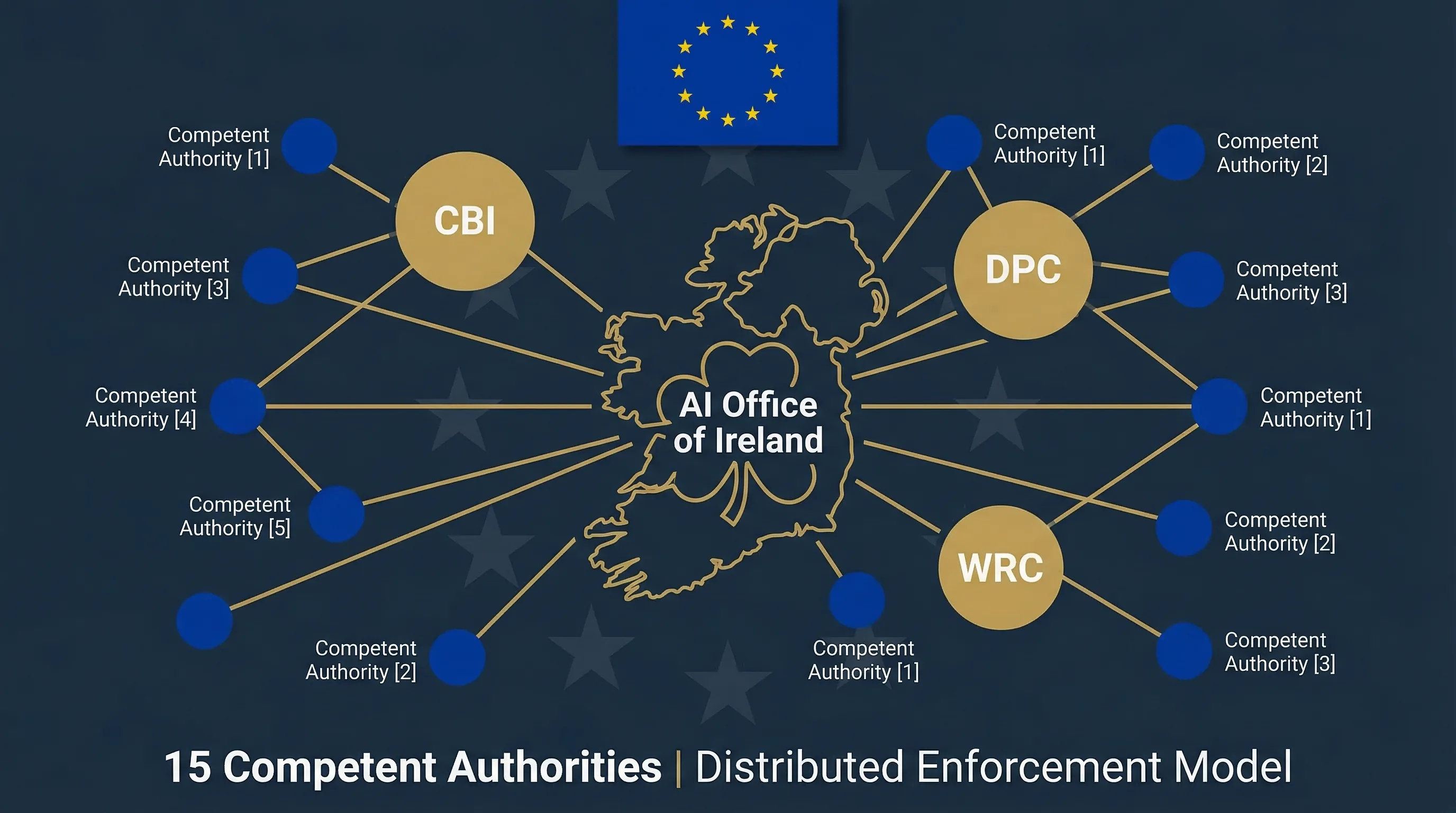
The Bill establishes the AI Office of Ireland (Oifig Intleachta Shaorga na hÉireann) as a new statutory independent body under DETE. It won't be a paper tiger. The AI Office becomes Ireland's Single Point of Contact under Article 70(2), coordinating with the European Commission, the EU AI Office, and 15 national competent authorities.
Why does this matter for your business? Ireland hosts European HQs for hundreds of tech companies — from Google and Meta to Stripe and dozens of fintechs. AI systems deployed from Ireland often serve the entire EU market. That means Irish enforcement will carry outsized weight.
Legislative status (March 2026): The General Scheme is in pre-legislative scrutiny at the Oireachtas Joint Committee on Enterprise, Tourism and Employment. Public submissions close 13 April 2026. The formal Bill hasn't been introduced yet. Once scrutiny ends, the Government drafts the Bill for passage through Dáil Éireann and Seanad Éireann. Target: enacted by August 2026.
Ireland chose a distributed regulatory model rather than creating one monolithic AI regulator. Fifteen existing sectoral authorities — bodies that already regulate financial services, data protection, health, media, and transport — keep enforcement within their domains. The AI Office sits on top, ensuring consistency and preventing fragmentation.
From what I've seen working with regulated firms, this distributed model has a practical upside: companies already know their primary regulator. If you're a CBI-regulated lender, you don't need to figure out a brand-new authority. You're dealing with the CBI for AI Act matters too.
Who Enforces the EU AI Act in Ireland?
Ireland designated its first 8 competent authorities on 5 March 2025, formalised through Statutory Instrument No. 366/2025 on 29 July 2025. Seven more were added on 16 September 2025, bringing the total to 15. These authorities form the National AI Implementation Committee, which held its first meeting on 16 September 2025.
AI Office of Ireland — Central Coordinator
The AI Office handles four core functions: coordinating enforcement across all 15 authorities, serving as the EU AI Act Single Point of Contact, providing technical expertise to sectoral regulators, and coordinating Ireland's national sandbox route. Regulation (EU) 2026/1744 requires at least one national AI regulatory sandbox to be operational by 2 August 2027; verify Ireland's current implementation and authority arrangements.
| Authority | Sector | ICP Relevance |
|---|---|---|
| Central Bank of Ireland (CBI) | Financial services, payments, insurance, lending | Critical |
| Data Protection Commission (DPC) | GDPR + AI Act overlap where personal data is processed | Critical |
| Coimisiún na Meán | AI in audiovisual media services | Medium |
| ComReg | Telecommunications, digital communications | Medium |
| CCPC | Consumer protection, competition | Medium |
| Workplace Relations Commission | AI in employment (hiring, workforce management) | Critical |
| HIQA | Healthcare, social care | Sector-Specific |
| HSE | High-risk AI in essential public health, emergency triage | Sector-Specific |
| HPRA | AI in medical devices, pharmaceuticals | Sector-Specific |
| HSA | Occupational health and workplace safety | Niche |
Additional authorities include the Commission for Railway Regulation, National Transport Authority, Commission for Regulation of Utilities, and the Marine Survey Office (Department of Transport). Are you operating across multiple sectors? You could face supervision from several authorities simultaneously — that's where the AI Office's coordination role becomes critical.
AI Regulatory Sandbox
Under Article 57, Ireland must establish at least one regulatory sandbox by 2 August 2027. The AI Office will operate it, with SMEs and startups getting priority access. The DPC provides oversight for personal data processing within sandbox testing. If you're an early-stage company building AI products, this is the structured pathway for testing before full market deployment.
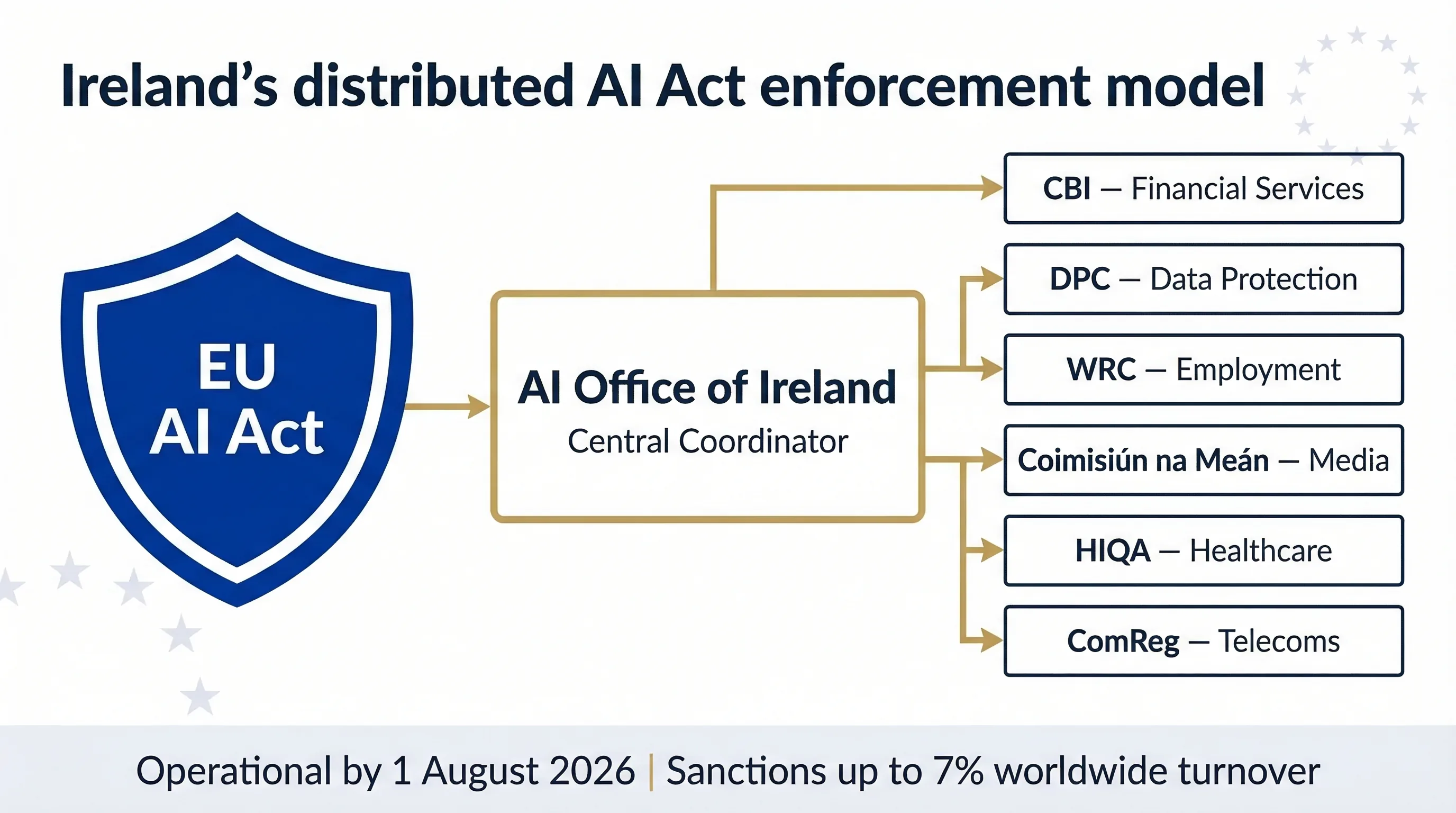
Ireland's distributed enforcement model: 15 competent authorities coordinated by the AI Office of Ireland.
Ireland-Specific Compliance Considerations
CBI-Regulated Firms: Dual Oversight
If you're a CBI-regulated firm — payment institution, e-money institution, retail credit firm, credit servicing firm — deploying AI in regulated activities, you face dual oversight. The CBI supervises financial regulation; the CBI and AI Office jointly handle AI Act enforcement in financial services. The CBI's existing technology risk supervisory expectations (IT risk guidance, outsourcing requirements) will extend into AI governance. Firms already engaged with the CBI Innovation Hub can use that channel for early AI Act readiness discussions.
DPC/GDPR Overlap
The DPC has been Europe's most active data protection authority — think of the fines against Meta, WhatsApp, and the enforcement action on X's Grok AI tool in 2024. Expect a similarly aggressive posture on AI Act enforcement wherever personal data is involved. AI systems processing personal data of EU residents deployed from Ireland face combined DPC + AI Office scrutiny. If you're a deployer processing personal data with high-risk AI, your DPIA obligations under GDPR and your fundamental rights impact assessment under the AI Act now overlap. Don't treat them as separate exercises.
Employment and Workforce AI
Ireland doesn't have German-style works council co-determination, but the AI Act's Article 26(7) workplace notification requirement still applies: you must inform employees or their representatives before deploying high-risk AI in the workplace. The Workplace Relations Commission is the designated authority here. AI used in hiring, promotion, or termination decisions falls under Annex III high-risk classification regardless of Irish employment law specifics.
Enforcement Powers and Penalties
The enforcement toolkit is extensive. Market surveillance authorities can require documentation, conduct inspections, obtain product samples, and — in a provision that's alarmed some providers — request access to source code for high-risk AI systems as a last resort. Penalties follow the EU AI Act tiers:
| Violation Category | Maximum Fine | % of Worldwide Turnover |
|---|---|---|
| Prohibited AI practices (Article 5) | €35 million | 7% |
| High-risk AI non-compliance | €15 million | 3% |
| Incorrect/misleading information to authorities | €7.5 million | 1% |
| Public sector bodies | €1 million | N/A |
Administrative sanctions go through an independent adjudicator nominated by the AI Office and confirmed by the High Court. Appeals can be filed within 28 days. This isn't a rubber-stamp process — there are real procedural safeguards built in.
Key Dates for Ireland
| Date | Milestone | Status |
|---|---|---|
| 5 March 2025 | First 8 competent authorities designated | ✓ Done |
| 29 July 2025 | S.I. 366/2025 gives legal effect to designations | ✓ Done |
| 16 September 2025 | 7 more authorities added (total 15); first AI Implementation Committee meeting | ✓ Done |
| 4 February 2026 | General Scheme of AI Bill published | ✓ Done |
| 13 April 2026 | Pre-legislative scrutiny submissions close (Joint Committee on Enterprise) | … Pending |
| 1 August 2026 | AI Office of Ireland must be operational | … Pending |
| 2 August 2027 | National AI regulatory sandbox operational deadline under the amended AI Act | — Future statutory date |
| 2 December 2027 | Relevant Chapter III Sections 1 to 3 provisions apply to Article 6(2)/Annex III systems | — Future statutory date |
Current EU timeline: Regulation (EU) 2026/1744 was published on 24 July 2026 and entered into force on 27 July 2026. The consolidated AI Act sets 2 August 2027 for national sandboxes and 2 December 2027 for the relevant Article 6(2)/Annex III high-risk provisions. Irish institutional and legislative implementation still requires current Irish-source verification.
FAQ: EU AI Act in Ireland
The AI Office of Ireland coordinates national enforcement as the central authority and Single Point of Contact. Fifteen competent authorities designated under S.I. 366/2025 retain enforcement in their sectors: the Central Bank of Ireland for financial services, the DPC for data protection, Coimisiún na Meán for media, and others. The General Scheme of the Regulation of Artificial Intelligence Bill 2026 was published on February 4, 2026 and is currently undergoing pre-legislative scrutiny.
The 2026 General Scheme stated that the AI Office should be operational by 1 August 2026. That historical target does not coincide with the current Article 6(2)/Annex III application date of 2 December 2027. The Office's current implementation status should be checked against current Irish Government and Oireachtas sources.
The Central Bank of Ireland retains sector-specific authority for AI systems used in regulated financial services. CBI-regulated firms deploying AI in credit decisioning, payments, or insurance face dual oversight: CBI for financial regulation and CBI plus the AI Office for AI Act enforcement. Prepare for AI governance expectations aligned with the CBI existing technology risk supervisory approach.
Under Article 57 of the EU AI Act, Ireland must establish at least one regulatory sandbox by 2 August 2027. The current Irish operating and access arrangements should be verified with the responsible Irish authorities. SMEs and startups receive priority access under the AI Act.
The EU AI Act applies directly as an EU Regulation. Irish implementing measures can supplement it with enforcement authority designations, procedural rules, penalty mechanisms, and institutional structure. Current Irish legislation and institutional arrangements require verification from official Irish sources. Existing Irish employment law, consumer protection legislation, and sector-specific rules may apply separately.
Free Compliance Tools for Irish Companies
EU AI Act Compliance Checker
5-minute assessment to check if your AI systems are in scope.
Deployer Self-Assessment
Map your deployer obligations under Articles 26-29.
Fraud vs Credit Scoring Delimiter
Financial services? Classify your AI: fraud detection vs credit scoring.
FRIA Tool
Fundamental Rights Impact Assessment generator.
Need More Practical Guidance?
Explore the free EU AI Compass tools and guides to classify your use case, understand your obligations, and move to the next compliance step.
Abhishek G Sharma
Founder, Move78 International | 20+ Years Cybersecurity & Risk Management
ISO 42001 LA • ISO 27001 LA • CISA • CISM • CRISC • CEH • CCSK • CAIGO • CAIRO
Disclaimer & Legal Notice
This guide provides general information about EU AI Act implementation in Ireland. It doesn't constitute legal advice. The Irish AI Bill is in pre-legislative scrutiny as of March 2026 and provisions may change before enactment. Consult qualified Irish legal counsel for compliance advice specific to your organisation. EU AI Compass and Move78 International Limited accept no liability for decisions made based on this content.
EU AI Act statutory baseline reviewed: 2 September 2026. Ireland-specific regulatory developments require current official verification before reliance.
Sources & Legal Basis
- • DETE — General Scheme of the Regulation of Artificial Intelligence Bill 2026
- • DETE — Ireland Designates 15 National Competent Authorities (September 2025)
- • Matheson — General Scheme of AI Bill Analysis (February 2026)
- • William Fry — Ireland AI Enforcement Blueprint (February 2026)
- • Oireachtas — Pre-Legislative Scrutiny Call for Submissions (March 2026)