Blog · Reviewed 9 May 2026 · 8 min read
The EU AI Act Delay Does Not Mean Pause
A practical evidence-work article for deployers separating provisions already applicable from future statutory application dates.
Reviewed: 2 September 2026.
Source basis: Regulation (EU) 2024/1689 as consolidated on 27 July 2026, Regulation (EU) 2026/1744, and the European Commission AI Act FAQ. Council and Commission press releases are used only for legislative history. This page is educational and does not provide legal advice or compliance guarantees.
Quick answer: Regulation (EU) 2026/1744 changed the statutory timeline, but it did not create a "do nothing until 2027" outcome. Under the current published AI Act operative baseline, prohibitions and AI literacy already apply, GPAI obligations already apply, Article 50 generally applied from 2 August 2026 and still needs route-specific review, and Article 6(1)/Annex I product-integrated high-risk AI applies from 2 August 2028 under Regulation (EU) 2026/1744.
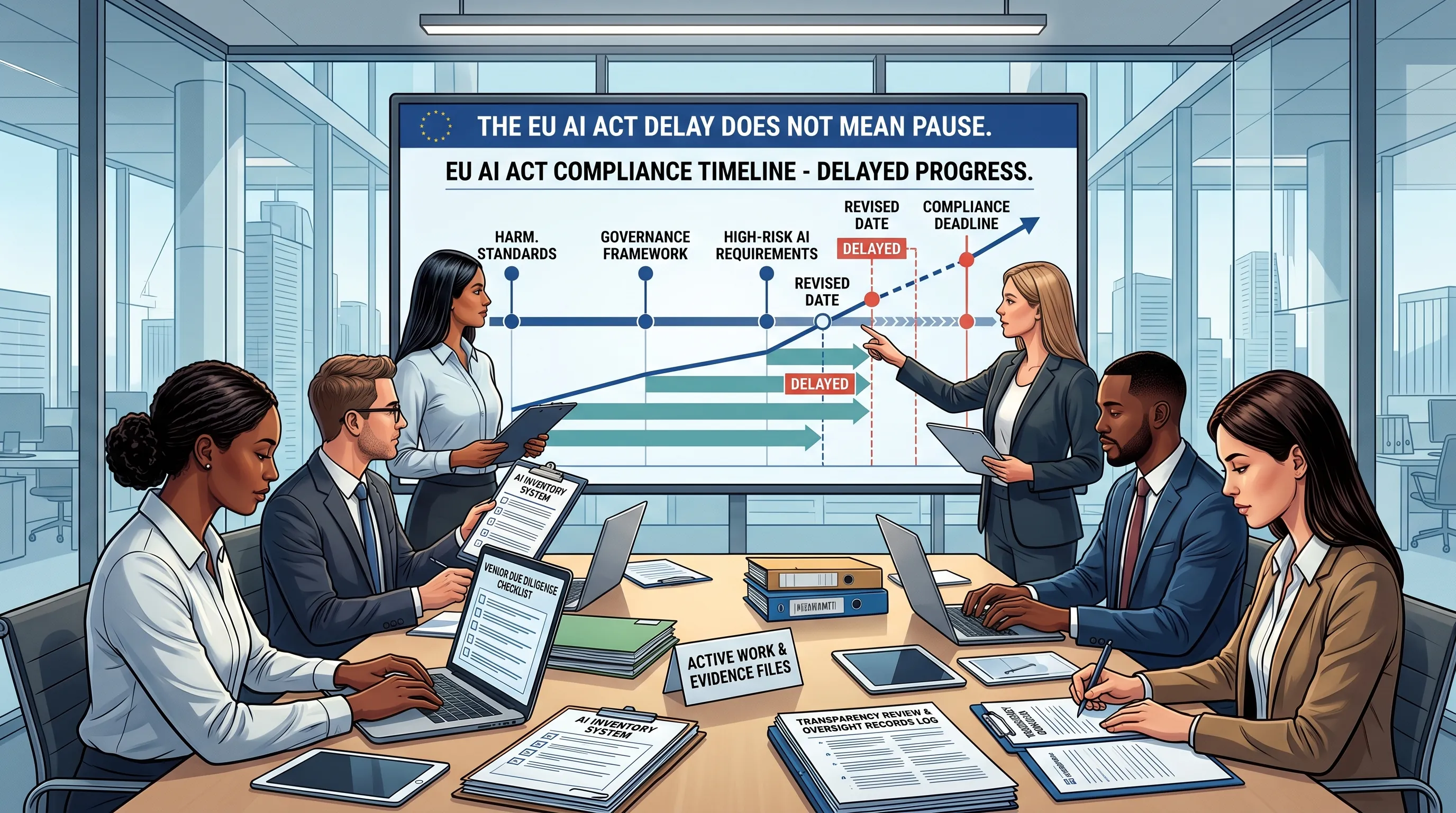
What moved
Regulation (EU) 2026/1744 sets later application dates for Article 6(2)/Annex III high-risk AI systems, 2 December 2027, and Article 6(1)/Annex I product-integrated high-risk AI systems, 2 August 2028. It also sets 2 August 2027 for national AI regulatory sandboxes and a narrow 2 December 2026 transition for providers of certain Article 50(2) systems placed on the market before 2 August 2026.
Planning rule: treat these as statutory application dates under the consolidated AI Act, while checking scope, exceptions and later official changes.
What did not disappear
Several obligations and workstreams did not vanish. Regulation (EU) 2026/1744 is in force and the consolidated AI Act current from 27 July 2026 controls the amended text. The original prohibited practices and Article 4 already apply. GPAI governance obligations already apply. Article 50 generally applied from 2 August 2026 and requires active route-specific implementation review now.
| Workstream | Why it still matters |
|---|---|
| AI system inventory | You cannot classify, assign ownership, review vendors, or plan evidence without a controlled system list. |
| Role mapping | A team still needs to know whether it is acting as deployer, provider, importer, distributor, or a mix. |
| Article 50 review | Transparency obligations remain a separate review track and should not be assumed to move with all high-risk dates. |
| AI literacy records | Article 4 is already applicable. Training evidence is not a 2027 task. |
| Decision log | A dated log shows whether a decision relied on binding law, final guidance, draft guidance, or another identified source. |
Why deployers still need evidence work in 2026
A delay in one part of the timeline does not remove the need to identify systems, map roles, review vendor claims, understand transparency triggers, document human oversight, retain logs, and prove AI literacy action. Buyers, boards, procurement teams, and auditors may ask for records before a regulator does.
The extra complexity is the point. When dates move, the file should explain which date the organisation used and why. Otherwise the organisation buys time and loses the audit trail.

Evidence work that still makes sense now
- AI system inventory: list systems, owners, vendors, purposes, data types, users, affected processes, and business-criticality.
- Role and legal-status mapping: record whether each decision relied on the consolidated current law, final guidance, draft guidance, or another clearly identified source.
- Vendor due diligence: request model capability, limitation, logging, oversight, content-marking, and safety-control evidence.
- Article 50 trigger review: check chatbot disclosure, deep fake, public-interest text, biometric categorisation, and emotion-recognition scenarios.
- Human oversight and use instructions: document what users can do, when they must escalate, and when AI outputs cannot be used alone.
- AI literacy records: keep training, attendance, curriculum, role mapping, and refresher evidence.
- Decision log: preserve the regulatory status used for each planning decision.
The real risk if teams pause
The real risk is loss of internal control. A paused team usually creates five avoidable gaps:
- no clean AI system inventory
- no vendor evidence trail
- no Article 50 trigger review
- no human oversight documentation
- no dated explanation for why one legal-status assumption was used over another
Better operating model: maintain a three-column tracker: duties already applicable, future statutory application dates, and the evidence needed for each route.
What to do next
Start with the timeline page. Then run the evidence checklist. Then check Article 50 triggers, vendor due diligence, and AI literacy status. The point is not to overbuild. The point is to avoid wasting the extra time.
FAQ
Direct answers on what the Digital Omnibus timeline shift changes, what still needs review, and which evidence remains useful.
No. The EU AI Act delay changed parts of the timeline discussion, but it did not remove the need for inventory, vendor due diligence, Article 50 review, oversight records, and AI literacy evidence. Evidence work should be sequenced, not paused.
Under the current AI Act baseline, prohibited practices and AI literacy already apply, GPAI obligations already apply, Article 50 generally applied from 2 August 2026 and needs route-specific review, and high-risk AI embedded in Article 6(1)/Annex I product-integrated high-risk systems apply from 2 August 2028 under Regulation (EU) 2026/1744.
A decision log matters because the regulatory picture includes provisions already applicable, future statutory application dates, final guidance, and draft guidance. A dated log shows which source and status your team relied on, which evidence was available, who approved the decision, and when it should be reviewed.
The most valuable evidence now is the material that remains useful across provision-specific application dates: AI system inventory, role mapping, vendor evidence, human-oversight steps, Article 50 trigger review, AI literacy records, and a source-status note.
No. The EU AI Act delay matters, but it should change sequencing rather than become an excuse to stop preparing. The practical risk is losing inventory discipline, vendor evidence, Article 50 review records, oversight documentation, and the audit trail for legal-status assumptions.