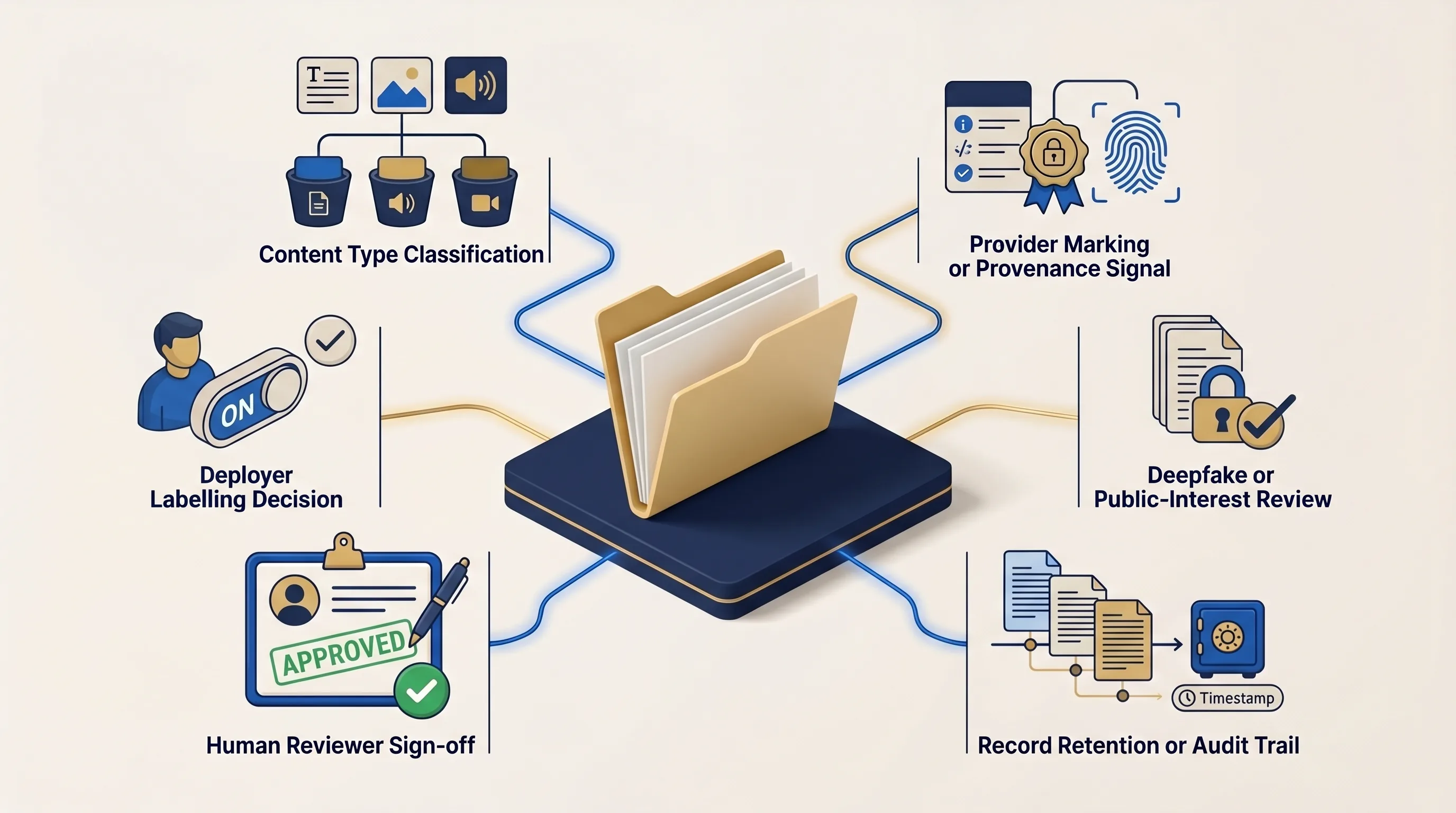
An Article 50 evidence file is not a named legal artefact in the AI Act. It is a practical record that helps deployers show how they classified AI-generated or manipulated content, checked provider marking, decided whether a human-facing label was needed, retained review evidence, and assigned follow-up before publication.
Why an Article 50 evidence file matters
The weak implementation pattern is simple: a label is added to a chatbot, image, video, or article, but no one can later explain the role decision, source basis, exception review, or approval path. That is not a records problem after the fact. It is a design problem before publication.
Article 50 creates several transparency duties for certain providers and deployers of AI systems. The deployer problem is not only knowing the rule. The harder work is retaining the operational record that shows what the organisation decided, who reviewed the decision, and what evidence was kept.
Record the decision before the content goes live. Retrospective reconstruction is weaker, especially when the same content moves across websites, apps, social posts, newsletters, screenshots, videos, or downloadable assets.
Provider marking and deployer labelling are different records
The first evidence-file decision is role separation. Provider marking and deployer labelling should not be collapsed into one checkbox.
| Record area | Provider marking evidence | Deployer labelling evidence |
|---|---|---|
| Core question | Does the AI system output include machine-readable marking or detectability support? | Does the organisation need to disclose AI-generated or manipulated content to natural persons? |
| Main Article 50 link | Article 50(2): marking machine-generated or manipulated audio, image, video, or text output where in scope. | Article 50(4): disclosure for deepfakes and certain AI-generated or manipulated public-interest text where in scope. |
| Evidence to retain | Vendor statement, technical documentation, provenance signal, watermark statement, metadata note, API documentation, or limitation note. | Label wording, placement, first-exposure timing, screenshot, approval owner, exception rationale, publication channel, and retention location. |
| Common failure | Relying on a vendor claim without recording what signal exists or where it can be verified. | Adding a visible label but keeping no record of why, where, when, or under whose review it was used. |
What an Article 50 evidence file should contain
The file should be short enough to use before publication, but specific enough to survive later review. Treat it as a decision record, not a legal memo.
AI system and vendor
Name the AI system, vendor, model or product family where known, version if available, deployment owner, and business function.
Content type and channel
Record whether the content is chatbot interaction, synthetic audio, image, video, deepfake, public-interest text, marketing copy, training material, or internal content.
Provider and deployer role decision
Separate the provider marking dependency from the deployer labelling decision. Do not assume one replaces the other.
Disclosure wording and placement
Keep the label text, where it appears, when a person first sees it, and whether the disclosure remains visible when content is shared or downloaded.
Reviewer and exception rationale
Record reviewer name, date, editorial responsibility, creative or legal-authorisation exception rationale where considered, and escalation owner.
Retained evidence
Keep screenshots, source links, vendor records, approval notes, content IDs, repository paths, publication dates, and follow-up actions.

Deepfakes and public-interest text need stronger records
Deepfake and public-interest text decisions deserve a tighter evidence trail because the user-facing risk is deception. The record should not stop at “AI label added.” It should show the review logic.
| Use case | Minimum evidence to retain | Review warning |
|---|---|---|
| Deepfake image, audio, or video | Content ID, generation or manipulation method where known, label text, label placement, first-exposure timing, creative or satirical context if relevant, reviewer, date, and screenshot. | Do not bury the disclosure in a place the viewer sees only after the content has already done its work. |
| AI-generated or AI-manipulated public-interest text | Publication context, public-interest rationale, reviewer, editorial responsibility, label decision, exception rationale, source basis, and retained version history. | Do not treat “human reviewed” as a vague statement. Record who reviewed the text and who accepted editorial responsibility. |
| Chatbot or interactive AI system | First-interaction notice, interface location, user journey screenshot, product owner, review date, and exception rationale if the interaction is obvious in context. | Do not assume branding alone informs the user that they are interacting with an AI system. |
EU icons, watermarks, metadata, and C2PA are evidence signals
EU icons, watermarks, metadata, provenance standards, and detection support can strengthen an evidence file. They should not be described as automatic compliance proof. Record what was used, what it covers, what it does not cover, and how a reviewer verified it.
- EU icons: record whether an icon was used, which variation was used, where it appeared, and whether text accompanied it.
- Watermark or metadata: record whether the mark survives export, compression, reposting, cropping, screenshotting, or platform upload.
- C2PA or equivalent provenance signal: retain the vendor statement, system setting, verification method, and limitation note.
- Automated detection: record the detector used, confidence limitations, review owner, and whether human review overrode the signal.
2 August 2026 is the readiness date. 2 December 2026 is not a blanket pause.
Article 50 generally applies from 2 August 2026. The Article 111(4) legacy transition applies only to providers of systems covered by Article 50(2) that were placed on the market before 2 August 2026, giving them until 2 December 2026 to comply with Article 50(2). It is not a reason to delay evidence design.
Build the evidence workflow before the publication team, product owner, legal reviewer, procurement lead, or vendor manager needs it. The record is easier to keep when it is part of the release process.
Common Article 50 evidence failures
- Label-only thinking: the organisation adds text but keeps no record of why that text was chosen.
- Vendor dependency without proof: the deployer relies on provider marking but keeps no vendor statement, setting record, or limitation note.
- EU icon overclaim: an icon is treated as proof rather than a disclosure aid.
- Exception drift: creative, editorial, or legal-authorisation exceptions are assumed informally and never approved.
- No retention owner: screenshots, notices, labels, and approvals are scattered across design files, CMS records, emails, and tickets.
Minimum checklist before publication
- Record the AI system, vendor, business owner, and content owner.
- Classify the content type: chatbot, synthetic media, deepfake, public-interest text, assistive edit, or other.
- Separate provider marking evidence from deployer labelling evidence.
- Record the label wording, location, timing, accessibility check, and screenshot.
- Record human review, editorial responsibility, legal exception review, and approval owner where relevant.
- Store vendor documentation, provenance notes, watermark notes, icon decision, and detection limitations.
- Assign a retention owner and review date.
- Revisit the file when the system, vendor, channel, content type or official guidance changes. The Commission published final Article 50 guidelines on 20 July 2026.
Need a broader implementation evidence pack?
Use the free Article 50 tools first. Review Move78 ACT-2 only when the disclosure record must connect to wider AI governance evidence such as ownership, vendor review, policy, board reporting, and implementation tracking.
ACT-2 is a file-based implementation evidence pack. It does not determine Article 50 scope, provide legal advice, or guarantee compliance, audit results, regulator acceptance, or buyer approval.
Article 50 evidence file FAQ
Short answers for deployers building Article 50 records before AI-generated content, deepfakes, or public-interest AI text are published.
No. "Article 50 evidence file" is an operational record structure, not a statutory file name in Regulation (EU) 2024/1689. The practical point is that deployers need a defensible record of the system, content type, role decision, disclosure decision, reviewer, source basis, and follow-up owner before AI-generated content is published or used.
The deployer should record the AI system or vendor, intended use, content type, publication channel, and whether the organisation is relying on provider marking, deployer labelling, or both. This first record prevents a common failure: adding a label to content without keeping the role and source decision that explains why the label was used.
No. Provider marking and deployer labelling are different controls. Provider marking concerns machine-readable marking and detectability of outputs. Deployer labelling concerns human-facing disclosure for deepfakes and certain AI-generated or manipulated public-interest text. A deployer evidence file should record both the provider dependency and the deployer disclosure decision.
No. The Commission says EU icons are optional and that using them does not establish legal compliance by itself. An evidence file should record whether an EU icon was considered or used, where it appeared, whether a text label accompanied it, and whether the disclosure was visible at first exposure.
For public-interest text, record whether the text was AI-generated or AI-manipulated, the publication context, reviewer, editorial responsibility, label decision, exception rationale if considered, and retained evidence such as screenshots, workflow records, or approval notes. Do not treat human review as a casual checkbox. Record who reviewed what, when, and under which responsibility model.
Use the dates as timing checks, not as a reason to delay readiness. Article 50 generally applies from 2 August 2026. Article 111(4), as amended by Regulation (EU) 2026/1744, gives providers of systems covered by Article 50(2) that were placed on the market before 2 August 2026 until 2 December 2026 to comply with Article 50(2). Treat that as a provider-side marking transition, not as a transition for Article 50(4) or other Article 50 duties.
No. This guide is an educational evidence workflow for deployers. It does not determine legal status, confirm compliance, provide a conformity assessment, or replace qualified legal, privacy, procurement, editorial, sector, or security review. Use it to prepare a better record before asking for final advice.
Source and review note: EU AI Act regulatory status reviewed 2 September 2026. Source basis: Regulation (EU) 2024/1689 as consolidated from 27 July 2026, including Regulation (EU) 2026/1744; final non-binding Commission Article 50 guidelines published on 20 July 2026; the voluntary Commission Code of Practice on transparency of AI-generated content; European AI Office signing instructions; and Commission EU icons guidance. This page provides educational operational guidance, not legal advice, compliance assurance, audit assurance, conformity assessment, or official EU endorsement. Confirm legal, privacy, editorial, procurement, sector, and security decisions with qualified professionals.
Official source links: Regulation (EU) 2024/1689; Commission Code policy page; Commission Code Q&A; EU icons guidance.
Turn the guide into a working record.
Start with one AI-generated content use case. Run the checker, keep the source basis, and retain the label decision before publication.