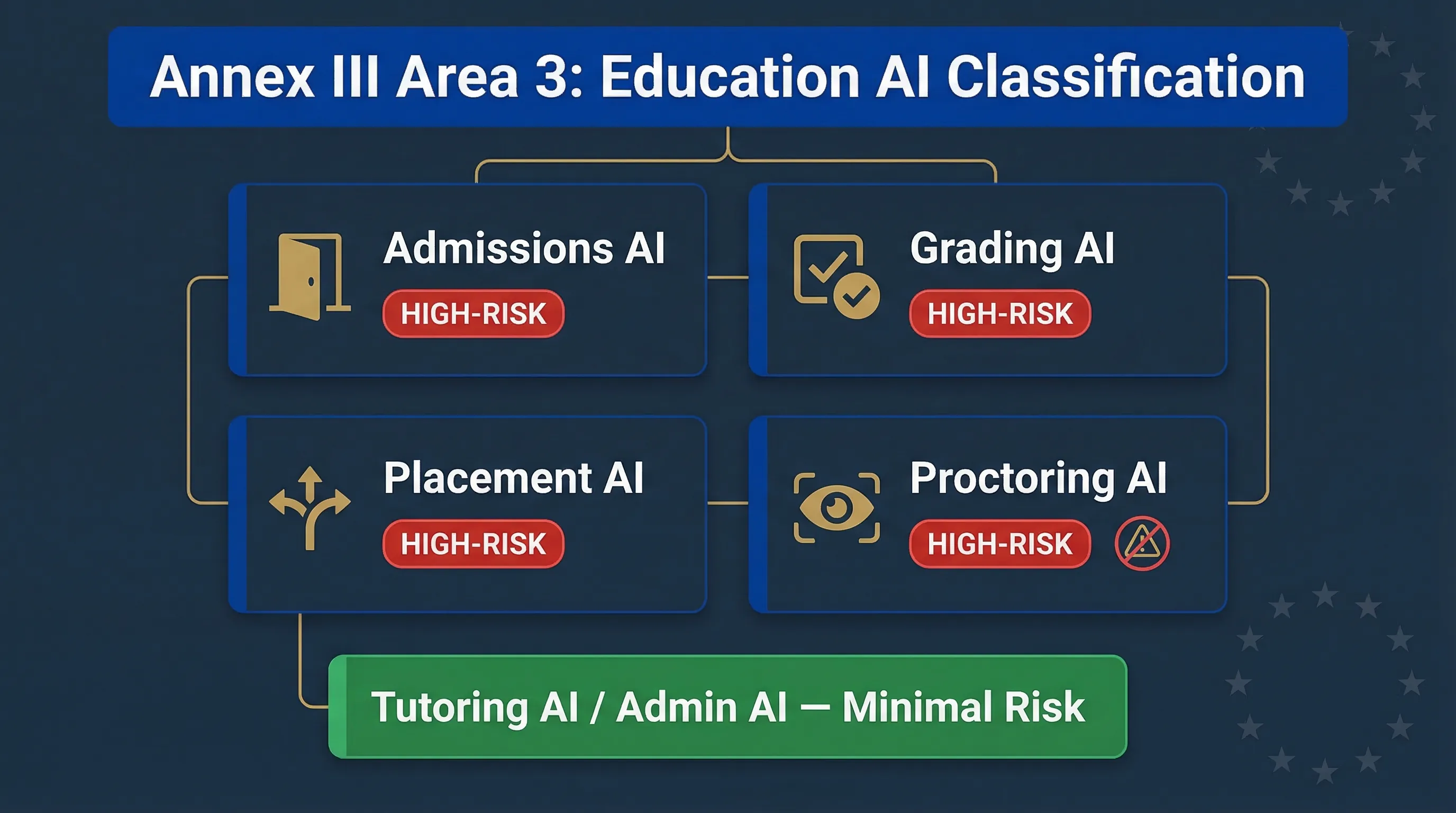
Annex III Area 3: Which Education AI Is High-Risk?
The EU AI Act doesn't treat education AI as a single category. Annex III Area 3 covers four distinct use cases, each with different implications. If you're an EdTech company or a university deploying AI assessment tools, the first question isn't "is AI in education regulated?" — it's "which of our specific systems trigger which classification?"
Category 1: AI Determining Access to Education
AI for admissions screening, applicant ranking, and acceptance or rejection recommendations. If AI influences who gets in and who doesn't, it's high-risk. This includes automated application scoring, AI that ranks applicants by predicted academic success, and algorithmic admissions filters. Enforcement begins December 2, 2027.
Category 2: AI Evaluating Learning Outcomes
Automated grading, essay scoring, and assessment evaluation. The trigger is "evaluating learning outcomes" — if the AI output contributes to a student's grade or certification, it's likely high-risk. AI-powered exam marking, automated essay grading systems, and AI that assigns grades or pass/fail determinations all fall here.
Category 3: AI Assessing Appropriate Level of Education
AI that determines student placement, course recommendations based on assessed ability, or vocational training assignments. Adaptive learning platforms that determine content difficulty and AI that recommends academic tracks based on performance data both fall under this category.
Category 4: AI Monitoring Prohibited Behaviour During Exams
AI proctoring systems that monitor students during tests. This is the most contested category. Webcam-based proctoring AI using eye tracking, face detection, or behavioural analysis combines biometric processing with behavioural monitoring, creating GDPR plus AI Act dual compliance requirements. Browser lockdown tools with AI monitoring and AI detecting phone use, impersonation, or unauthorised materials all fall here.
| Education AI Use Case | Annex III Classification | Additional Concerns |
|---|---|---|
| Admissions screening / ranking | HIGH-RISK Area 3 | Discrimination risk in applicant selection |
| Automated grading / essay scoring | HIGH-RISK Area 3 | Bias against non-native speakers |
| Student placement / level assessment | HIGH-RISK Area 3 | May entrench socioeconomic sorting |
| AI proctoring (exam monitoring) | HIGH-RISK Area 3 | Biometric data (Area 1) + possible Art. 5 prohibition |
| AI tutoring chatbot (no grading) | LIKELY NOT HIGH-RISK | Transparency obligations under Art. 50 |
| Plagiarism detection | DEBATABLE | High-risk if it directly influences grades |
| Administrative AI (scheduling) | MINIMAL RISK | No student access or outcome impact |
EdTech Company or Educational Institution: Who Has Which Obligations?
An EdTech company building an AI proctoring tool has completely different obligations from a university licensing that same tool. Getting this wrong means either missing provider obligations entirely or doing unnecessary work as a deployer. Which side of the line are you on?
EdTech Company Building the AI Tool
You're the provider. Full obligation stack: risk management system (Article 9), data governance (Article 10 — particularly sensitive for student data), technical documentation (Annex IV), human oversight design, accuracy and robustness, conformity assessment, CE marking, EU database registration, and post-market monitoring. If your tool processes biometric data like facial recognition in proctoring, you also face Annex III Area 1 requirements. And if it uses emotion recognition in an educational setting, you're potentially crossing into prohibited territory under Article 5(1)(f).
University, School, or Training Provider Deploying the AI
You're the deployer. Article 26 obligations apply: use per provider instructions, human oversight (teachers and examiners reviewing AI assessments before they become final), monitoring, logging, AI literacy for teaching staff, and transparency to students. Public educational institutions deploying high-risk AI must conduct a FRIA under Article 27 — most schools and universities are public bodies. If you modify the vendor's tool (custom rubrics, fine-tuning on local data, changing intended purpose), you risk becoming a provider under Article 25.
Emotion Recognition Prohibition in Education
Article 5(1)(f) prohibits emotion recognition systems in education settings, enforceable since February 2, 2025. AI proctoring that detects "suspicious behaviour" via facial expression analysis may cross this line. The boundary between "detecting prohibited behaviour" (permitted under Annex III) and "emotion recognition" (prohibited under Article 5) is a live regulatory question. Conservative recommendation: audit your proctoring tool's features. If it analyses facial expressions, eye movement patterns as emotional signals, or "stress indicators" — get legal advice before deploying in the EU.
| Role | Who | Key Obligations | Watch Out For |
|---|---|---|---|
| Provider | EdTech company, assessment platform developer | Art. 9–15, Annex IV documentation, conformity assessment, CE marking, post-market monitoring | Emotion recognition features in proctoring tools |
| Deployer | University, school, training provider | Art. 26: use per instructions, human oversight, FRIA (public bodies), AI literacy, transparency to students | Modifying vendor tools and inadvertently becoming a provider |
Role Classification Tools
Deep dive: For the full deployer framework, see the High-Risk AI Deployer Guide.
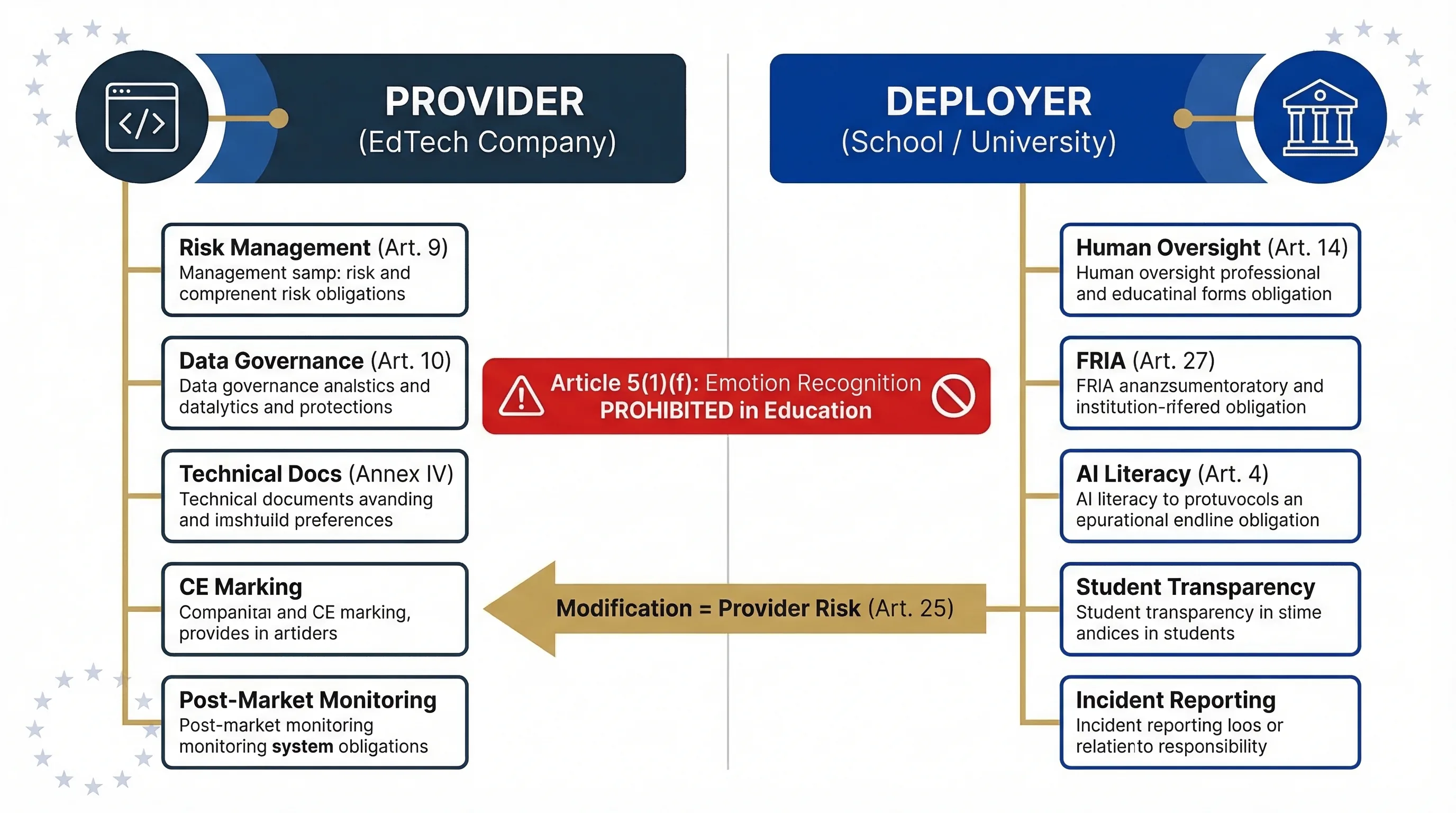
Classification map: how education AI use cases map to Annex III Area 3 categories and the Article 5(1)(f) emotion recognition prohibition.
Student Data Under GDPR and the EU AI Act: Dual Compliance
Student data — especially for minors — receives heightened protection under GDPR. GDPR Article 8 requires parental consent for processing children's data for information society services (age threshold varies by member state, typically 13–16). AI processing of student biometric data in proctoring requires a GDPR Article 9(2) legal basis for special category data in addition to the AI Act classification assessment.
DPIAs under GDPR Article 35 are likely to be required for many AI proctoring and automated grading systems, but the decision should be made through a case-specific DPIA trigger analysis. The AI Act's data governance requirements under Article 10 add a further layer: training, validation, and testing data must be relevant, representative, and as error-free as possible. For education, that raises a specific question: does the training data represent diverse student populations? Are non-native speakers disadvantaged by language model assumptions in essay grading?
Education AI compliance means satisfying both GDPR student data protections and EU AI Act system safety requirements. The two overlap on transparency, human oversight, and data quality, but each adds requirements the other doesn't cover.
What Educational Institutions Should Do Now
Five steps. No theory. Start this week.
Audit all AI tools in academic use
Assessment platforms, proctoring systems, admissions tools, adaptive learning platforms, plagiarism detectors. Ask each department what they use. Shadow AI in education is rampant — departments adopt tools without central IT approval. → Shadow AI Discovery Protocol
Classify each against Annex III Area 3
Does the tool determine access to education, evaluate learning outcomes, assess educational level, or monitor exam behaviour? If yes to any, it's likely high-risk. → EdTech Assessment Validator
Check proctoring tools for emotion recognition
If any proctoring tool analyses facial expressions or "stress" indicators, it may violate Article 5(1)(f). This has been prohibited since February 2, 2025. This is your highest-risk item. Get legal review.
Implement human oversight for automated grading
No AI-generated grade should become final without teacher or examiner review. Document the oversight arrangement, including who reviews, their competence, and how they override. → Human Oversight Log
Conduct FRIA (public institutions)
Public schools and universities deploying high-risk AI must complete a Fundamental Rights Impact Assessment under Article 27 before deployment. → FRIA Generator
FAQ: EU AI Act for Education and EdTech
These answers support practical triage. Confirm final classifications, reporting decisions, and legal obligations with qualified counsel or the relevant competent authority.
Yes. AI monitoring students during exams falls under Annex III Area 3, enforceable December 2, 2027. If the proctoring uses biometric data like facial recognition, it also triggers Annex III Area 1 requirements. If it analyses emotions, it may be prohibited under Article 5(1)(f), which has been enforceable since February 2, 2025. Use the EdTech Assessment Validator to check your systems.
If AI evaluates learning outcomes that contribute to a student's grade, certification, or progression, it's likely high-risk under Annex III Area 3. An AI writing assistant that helps students draft without grading is likely not in scope. The distinction is whether the AI output feeds into a formal assessment decision.
If the AI determines access to education or evaluates outcomes — yes. If it only recommends content without gating access, it's likely not high-risk but may still have transparency obligations under Article 50. Classify based on what the AI actually does, not the organisation type.
Article 5(1)(f) prohibits emotion recognition in educational settings with limited exceptions. This has been enforceable since February 2, 2025. AI proctoring that detects "suspicious behaviour" via facial expression analysis may cross into prohibited territory. This is a live regulatory question — audit your proctoring tool's specific features.
Annex III Area 3: December 2, 2027. Prohibited practices including the emotion recognition ban: already enforceable since February 2, 2025. AI literacy under Article 4: applied from February 2, 2025.
Under GDPR Article 8, processing children's personal data for information society services requires parental consent (age threshold varies by member state, typically 13–16). AI proctoring and assessment tools processing student data — especially biometric data — should be assessed for GDPR DPIA triggers and may require explicit consent or another Article 9(2) basis for special category data, depending on the deployment facts and Member State context.
All Education AI Compliance Tools
EdTech Assessment Validator
Check education AI classification
Biometric Identity Validator
For proctoring with facial recognition
EU AI Act Compliance Checker
General system classification
Accidental Provider Classifier
Check if modifications make you a provider
Deployer Self-Assessment
Check your deployer duties
Shadow AI Discovery Protocol
Find undisclosed AI tools in use
FRIA Generator
Build your impact assessment
Human Oversight Log
Track teacher override decisions
AI Literacy Planner
Build staff training programme
Need More Practical Guidance?
Explore the free EU AI Compass tools and guides to classify your use case, understand your obligations, and move to the next compliance step.
Disclaimer & Limitations
This guide is for educational and informational purposes only. It does not constitute legal or regulatory advice. EU AI Compass tools are educational aids, not certified compliance instruments. Consult qualified legal counsel before making compliance decisions. Move78 International Limited is not a law firm or authorised compliance service provider. All regulatory references are accurate as of the publication date based on eu-ai-rules-engine v2.8. The Digital Omnibus amendments are enacted in Regulation (EU) 2026/1744, with provision-specific application dates.