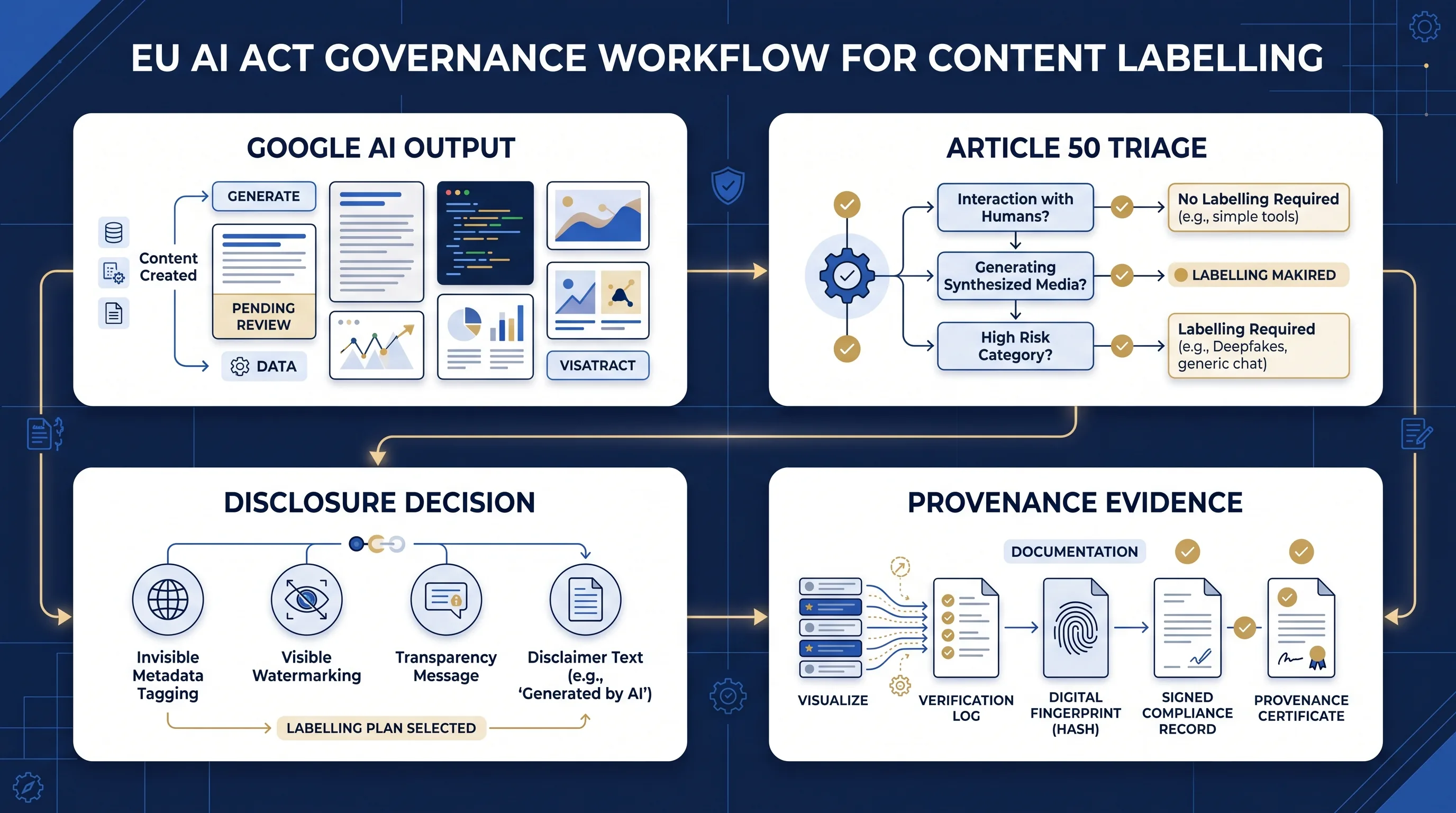
Quick answer
Google AI provenance helps evidence. It does not decide Article 50 by itself.
For EU AI Act Article 50, the practical question is not only whether Google AI created the content. You need to check the content type, audience, publication purpose, human review, and whether the person exposed to the content receives a clear notice at the right time.
Decision record
Use one short record before the content goes live.
The useful evidence is not a long policy memo. Keep a small record that links the Google AI tool, content channel, reviewer, notice wording, provenance signal, and final approval owner.
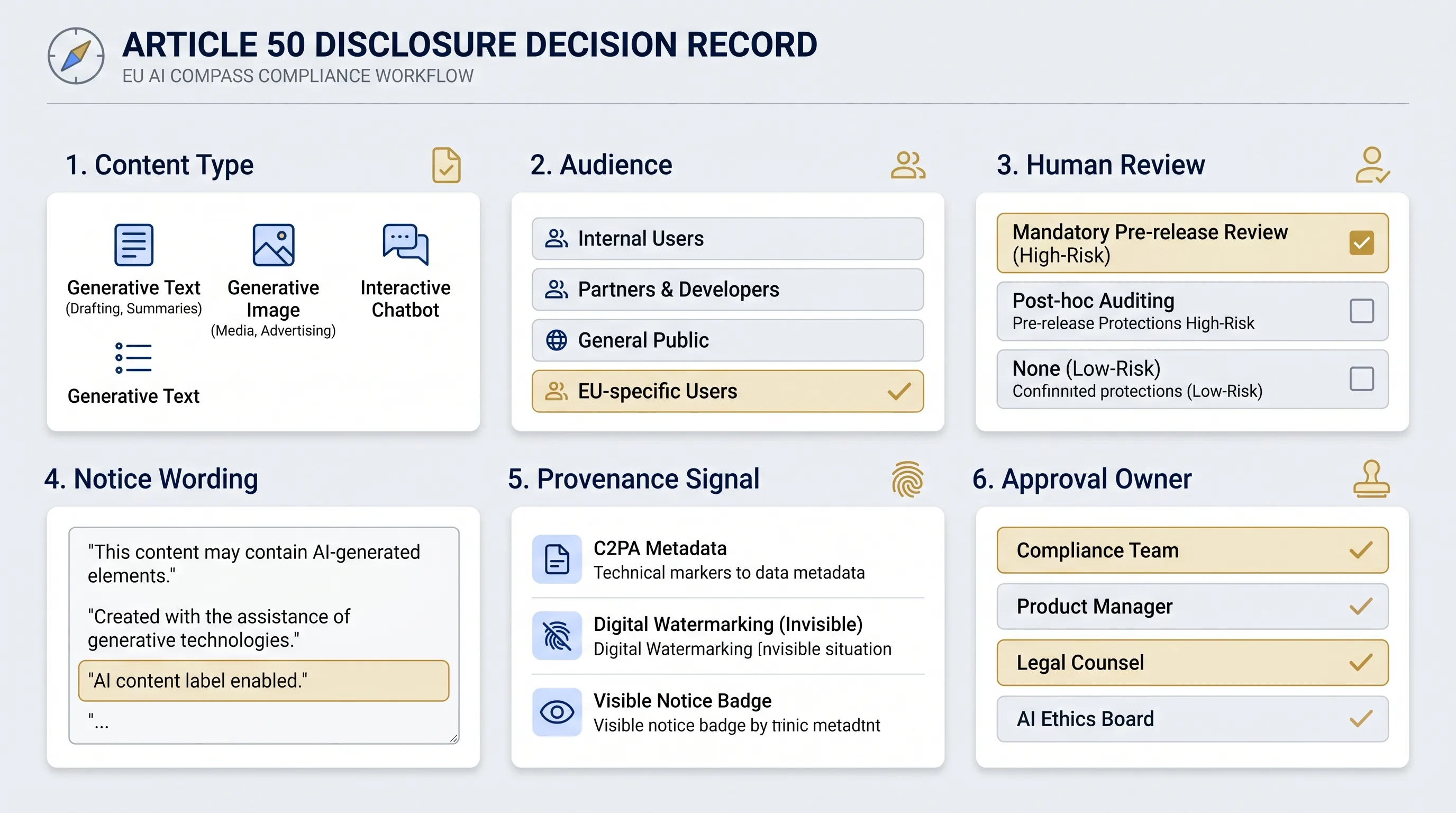
Run one content item through the triage.
Do not paste confidential or personal data. Use generic descriptions such as “public blog image,” “customer chatbot,” or “internal Gemini draft.”
Keep the decision record short.
The useful record is a small table. It should show what was generated, where it was published, who approved it, and why the notice decision was made.
Content record
Tool used, content type, public or internal channel, publication date, and whether the content is text, image, audio, video, or chatbot interaction.
Disclosure decision
Notice needed, notice not needed, or legal review required. Keep the reason, not only the final answer.
Review evidence
Human reviewer, editorial owner, provenance signal, source file location, approval date, and next review trigger.
Policy route after the checker
If the checker identifies a likely Article 50 labelling or disclosure record, use the AI Generated Content Labelling Policy Template to assign owner, label placement, EU icon decision, signatory route, exception handling, evidence retention, and review cadence.
Common questions
These answers are written for quick Article 50 triage, not final legal classification.
Does Google AI content always need an EU AI Act Article 50 label?
Google AI content does not always need an Article 50 label. The answer depends on the content type, whether people interact with an AI system, whether image, audio, or video content is a deepfake, whether text is published to inform the public on a matter of public interest, and whether any exception or human editorial review applies.
Does SynthID or C2PA evidence replace an Article 50 disclosure?
SynthID, C2PA Content Credentials, metadata, or watermarking can support an evidence record, but they do not replace the deployer’s Article 50 review. A team still needs to decide whether a user-facing notice, deepfake disclosure, public-interest text disclosure, publication note, or legal review is needed for the specific content and channel.
What evidence should a Google AI deployer keep?
A Google AI deployer should keep the content type, tool used, purpose, audience, publication channel, human review owner, disclosure decision, notice wording, provenance signal, and approval date. The record should be tied to an AI inventory entry so later audit, legal, privacy, or communications review does not depend on memory.
Is this checker legal advice?
This checker is not legal advice. The checker creates an operational triage record for Article 50 review. Use the result to prepare a discussion with legal, privacy, communications, product, or sector counsel before publishing high-impact or public-facing AI-generated content.
Use the free checker to build a cleaner Article 50 review record.
EU AI Compass is keeping this Google AI Article 50 checker free. Use the result for triage, internal review, and evidence planning. For final disclosure wording, publication decisions, or high-impact public content, review the record with qualified legal, privacy, communications, or sector counsel.