Executive Overview
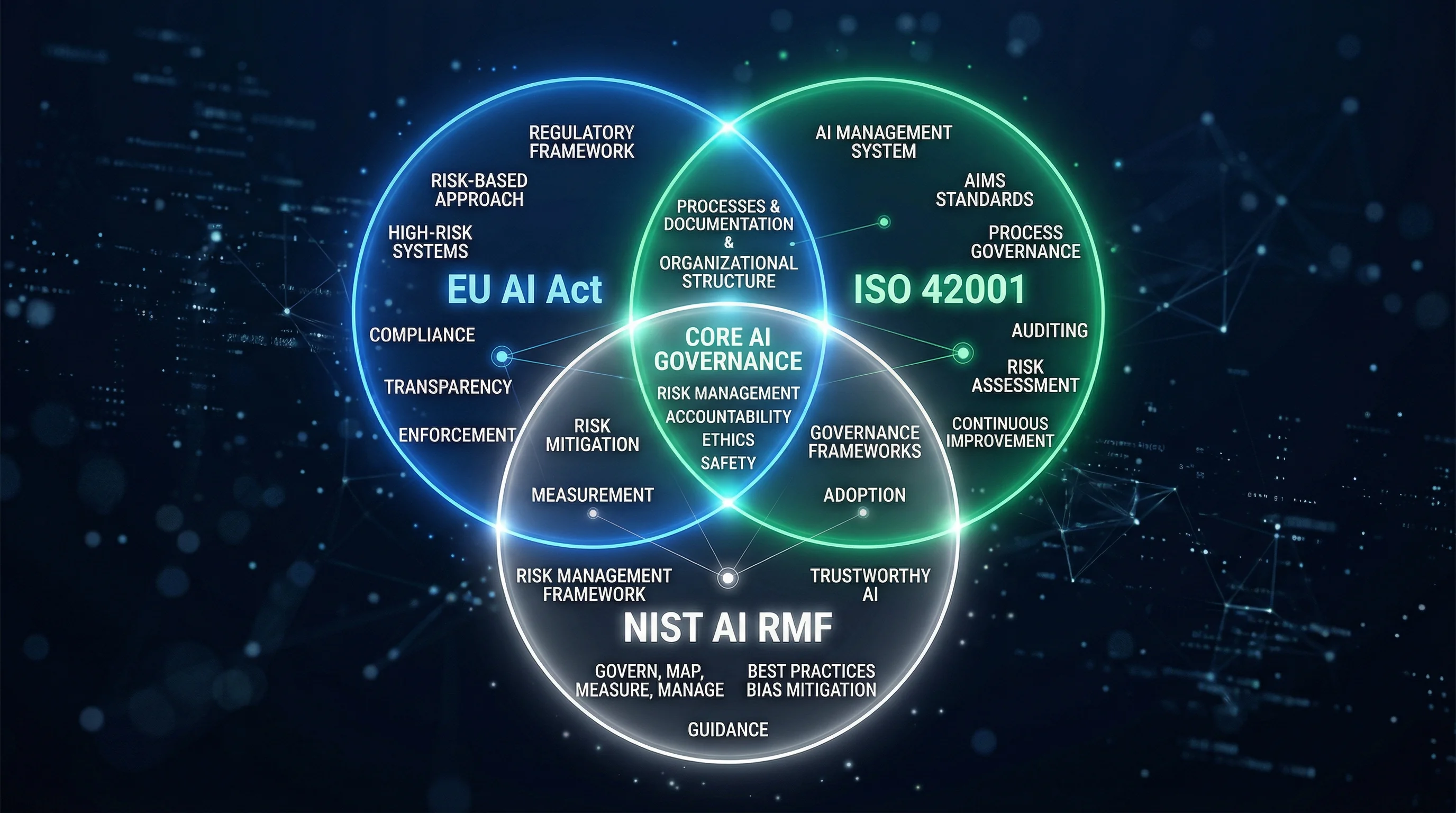
Organizations currently face three primary, overlapping governance frameworks. The EU AI Act is a binding legislative mandate with severe financial penalties. ISO/IEC 42001 is a certifiable management system standard. The NIST AI RMF acts as a voluntary governance guide.
These three frameworks share approximately 70% to 80% operational overlap regarding risk management and oversight. Organizations with existing ISO 42001 certification possess a significant head start but face critical gaps in the prescriptive data governance requirements of Article 10.
Organizations navigating the AI regulatory environment must manage three distinct but converging frameworks. Understanding the exact deltas between these standards is critical for building a defensible compliance program. ISO/IEC 42001, published in December 2023, establishes the management system baseline. The NIST AI RMF, released in January 2023, provides the sociotechnical analytical depth. Both served as blueprints for the operational requirements finally codified in the EU AI Act.
The Strategic Mapping
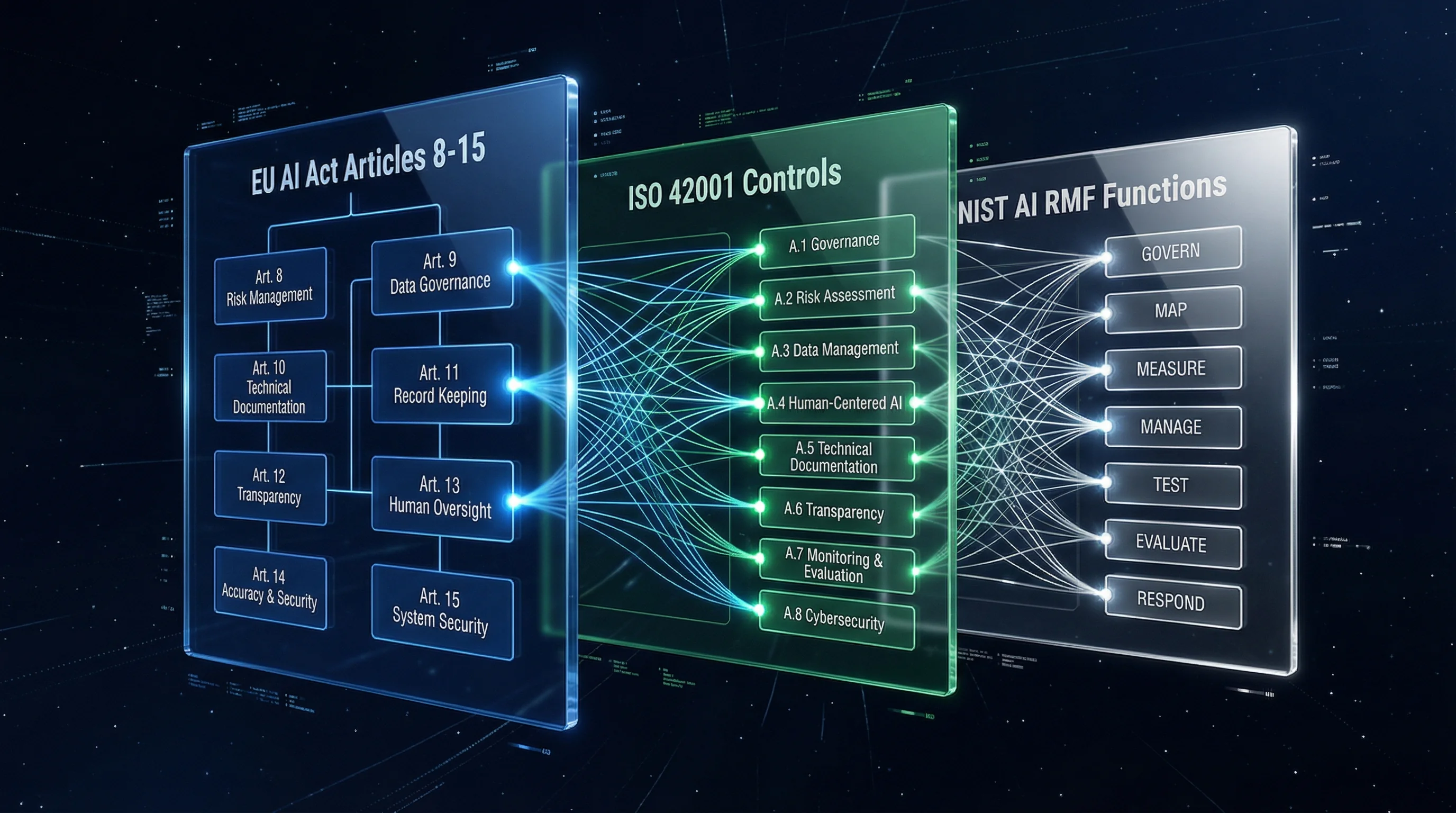
A clinical crosswalk reveals five primary areas of convergence where existing work can be leveraged to satisfy the EU AI Act.
- Risk Management: All three frameworks mandate systematic identification. Article 9 requirements map directly to ISO 42001 Clause 6.1 and the NIST GOVERN and MAP functions. A mature ISO 42001 risk process covers nearly 80% of the Article 9 technical burden.
- Data Governance: This is the primary gap. Article 10 enforces prescriptive requirements for training and testing data. While ISO 42001 Annex A.8 and NIST MAP 1.1 address data management, they lack the legal prescriptiveness regarding bias complete evaluation and statistical properties found in the AI Act.
- Technical Documentation: Article 11 and Annex IV specifying exact technical records map to ISO 42001 Clause 7.5. The EU AI Act is notably more granular, requiring documented design methodologies and validation results that voluntary standards only recommend.
- Human Oversight: Article 14 mandates effective intervention capabilities. This converges with ISO 42001 Annex A.5 and NIST GOVERN 1.5. The AI Act distinguishes itself by requiring specific physical override mechanisms and anomaly detection capabilities.
- Accuracy and Robustness: Article 15 performance requirements align with ISO 42001 Annex A.7 and the NIST MEASURE function. For ISO 27001 certified entities, the cybersecurity component of Article 15 will overlap significantly with established Information Security Management System (ISMS) controls.
Critical Regulatory Deltas
Despite the overlap, the EU AI Act enforces three unique mandates that possess no equivalent in voluntary standards.
- Categorical Prohibitions: The Article 5 prohibition regime is unique to the Act. Neither ISO 42001 nor NIST forbids any specific AI practice; they focus strictly on risk mitigation, not prohibition.
- Conformity Procedures: CE marking requirements and the formal conformity assessment process are regulatory constructs. They have no voluntary standard equivalent and cannot be satisfied through simple certification.
- Statutory AI Literacy: Article 4 requires providers and deployers to take measures supporting the development of sufficient AI literacy, whereas voluntary frameworks treat training as a best practice.
Actionable Recommendation
For organizations starting from scratch, we advise prioritizing the EU AI Act technical requirements to mitigate immediate legal and financial risk. Subsequently, organizations should adopt ISO 42001 controls to establish management system maturity. Finally, the NIST AI RMF should be utilized to add sociotechnical depth to the risk assessment process.
Organizations with existing ISO 42001 certification should focus their gap analysis exclusively on the prescriptive data governance of Article 10 and the rigid documentation specifics of Annex IV.
For broader ISO 42001 and NIST AI RMF implementation support beyond the free EU AI Compass tools, visit Move78 International. For an immediate preliminary classification, utilize our free Compliance Checker.

About the author: Abhishek G Sharma is the founder of Move78. He holds ISO 42001 Lead Auditor, CISA, CISM, CRISC, and CEH certifications. This analysis is grounded in over 20 years of experience across ISO 27001, NIST, and emerging AI governance architectures.
Disclaimer: This analysis is for educational purposes only and does not constitute formal legal advice. Consult qualified regulatory counsel for binding compliance decisions. EU AI Act statutory baseline reviewed: 2 September 2026. Standards and framework content requires current source-owner verification.