
Executive Summary
The original Article 5 text prohibited eight categories of AI practices outright. These include social scoring, subliminal manipulation, workplace emotion recognition, and untargeted facial recognition scraping. Those original provisions applied from 2 February 2025.
Breaches of applicable Article 5 prohibitions can fall within the AI Act's highest administrative-fine tier, subject to the statutory calculation, circumstances and enforcement process. If a current use is prohibited, do not continue it while seeking a compliance workaround; stop the use and obtain qualified legal advice.
Article 5 of the EU AI Act establishes an absolute regulatory floor. Its original text defined eight categories of AI practices; Regulation (EU) 2026/1744 added further provisions that apply from 2 December 2026. These practices cannot be mitigated through compliance frameworks, conformity assessments, or regulatory sandboxes. They are banned unequivocally.
Use the consolidated Article 5 text rather than treating the original count of eight as a complete current map. The scope, conditions and exceptions must be assessed provision by provision.
For an interactive technical screening, explore our Prohibited Practices module within the EU AI Compass application, or utilize our 12-question Compliance Checker to conduct a preliminary organizational audit.
1. Subliminal, Manipulative, or Deceptive Techniques: Article 5(1)(a)
This prohibition targets AI systems utilizing subliminal, manipulative, or deceptive techniques to materially distort human behavior. The legal threshold requires the distortion to cause, or be likely to cause, significant physical or psychological harm.
This extends far beyond standard commercial persuasion. It aggressively captures digital dark patterns deployed at scale. Example: An AI recommendation engine that actively exploits recognized cognitive biases to systematically steer elderly consumers toward highly unfavorable financial products.
2. Exploitation of Vulnerable Groups: Article 5(1)(b)
This provision bans AI systems engineered to exploit specific human vulnerabilities linked to age, disability, or socioeconomic circumstances. The regulatory objective is to prevent material behavioral distortion that results in significant harm.
This prohibition transcends general targeted advertising. It specifically isolates systems designed to capitalize on a user's reduced capacity for resistance. Example: An AI-driven telemarketing system that utilizes voice analysis to detect cognitive decline in elderly respondents, subsequently altering its sales script to exploit that confusion.
3. Social Scoring: Article 5(1)(c)
Article 5(1)(c) covers public and private actors. It concerns AI evaluation or classification of people or groups over time using social behaviour or known, inferred or predicted personal or personality characteristics, where the social score leads to detrimental or unfavourable treatment either in contexts unrelated to those in which the data was generated or collected, or that is unjustified or disproportionate to the social behaviour or its gravity. A score alone does not establish this prohibition.
An example to screen is a municipal or private housing provider using AI to score people over time from unrelated social-media behaviour, then denying them housing because of that score. Apply the conditions above; public or private status does not decide whether the prohibition is met.
4. Predictive Policing Based Solely on Profiling: Article 5(1)(d)
This clause prohibits AI systems from assessing the risk of an individual committing a criminal offense based solely on profiling or personality traits. Risk assessments must be grounded in objective, verifiable facts directly linked to past criminal activity.
Law enforcement agencies retain the ability to utilize AI for factual evidence analysis. However, predictive policing driven purely by demographic or behavioral modeling is strictly illegal. Example: An algorithm flagging a citizen as a high-risk theft suspect based exclusively on their residential postal code, employment status, and web browsing history.
5. Untargeted Facial Recognition Database Scraping: Article 5(1)(e)
The Act strictly forbids the creation or expansion of facial recognition databases via the untargeted scraping of internet images or CCTV footage. This does not constitute a blanket ban on facial recognition technology.
Instead, it outlaws the mass, indiscriminate harvesting of biometric data without documented consent or specific targeting parameters. Example: A commercial software vendor automatically scraping millions of public social media profiles to train a proprietary facial identification model.
6. Emotion Recognition in Workplaces and Schools: Article 5(1)(f)
Deploying AI to infer the emotional states of individuals within workplaces or educational institutions is strictly prohibited. This represents a highly consequential commercial restriction for mid-market enterprises.
Corporate tools claiming to monitor employee engagement, stress levels, or student attentiveness via facial analysis or voice telemetry are now illegal in the EU. Narrow exemptions exist strictly for medical or safety purposes, such as detecting commercial driver fatigue. Violating this specific ban exposes enterprises to the maximum penalty tier.
7. Biometric Categorization Inferring Sensitive Attributes: Article 5(1)(g)
It is illegal to deploy AI systems that categorize natural persons based on biometric data to deduce sensitive attributes. These protected attributes include race, political opinions, trade union membership, religious beliefs, sex life, and sexual orientation.
Extracting demographic classifications from facial geometry or vocal patterns violates this mandate. Example: A retail analytics platform utilizing in-store cameras to sort customers by inferred ethnicity in order to serve hyper-targeted digital advertisements.
8. Real-Time Remote Biometric Identification in Public Spaces: Article 5(1)(h)
The use of real-time remote biometric identification systems in publicly accessible spaces for law enforcement purposes is banned. The legislation permits three exceptionally narrow law enforcement exemptions: searching for specific victims of serious crimes, preventing genuine threats to life or terrorist attacks, and identifying suspects of specific severe offenses.
Every single exception demands prior judicial or administrative authorization. For all private enterprises and non-law-enforcement entities, real-time public biometric identification is banned unconditionally.
Regulation (EU) 2026/1744: Non-Consensual Intimate-Image / CSAM AI Prohibitions
Regulation (EU) 2026/1744 adds Article 5(1)(ba) and (bb) and related paragraphs for AI practices involving realistic non-consensual intimate or sexually explicit material of identifiable natural persons and CSAM-related material, subject to the statutory conditions and exceptions. In practical terms, this is the Digital Omnibus intimate-image and CSAM safety update that product, platform, and synthetic-media teams should assess under the consolidated Article 5 text and the 2 December 2026 application date.
These provisions are in force but apply from 2 December 2026. Organisations should not describe them as already applicable before that date. Teams offering image-generation, avatar or synthetic-media products should prepare their safety controls and evidence now.
Scope definition still matters. Organisations operating AI image tools should read the final consolidated provisions, including their conditions and exceptions, and treat this area as a product-governance hotspot before the new rules apply on 2 December 2026.
Practical Audit Steps
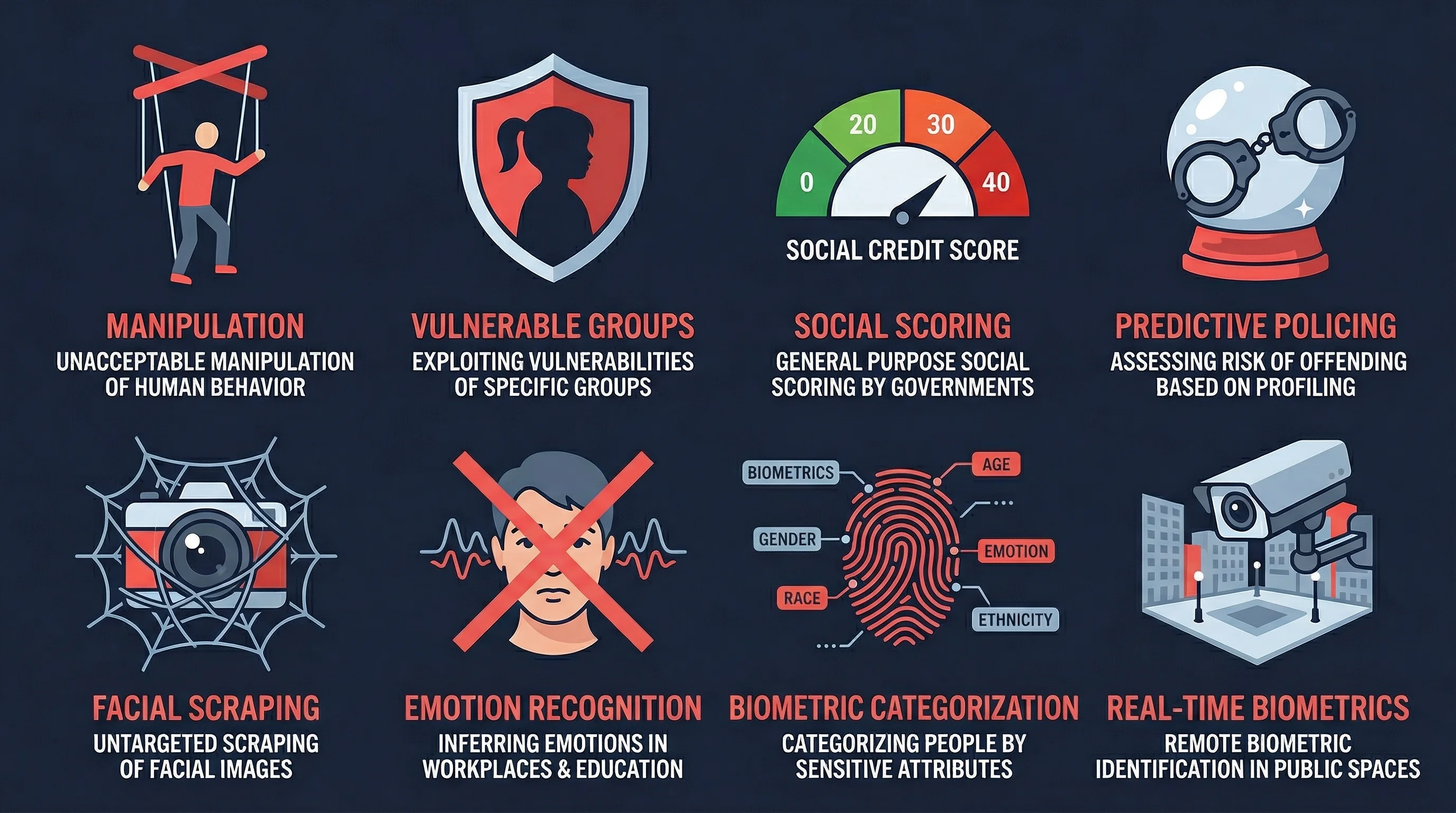
Organisations should audit their existing AI portfolios against the eight original operational boundaries and the new provisions. Immediate scrutiny should be applied to:
- Employee monitoring and productivity tools (Prohibition 6).
- Customer analytics platforms utilizing biometric or behavioral profiling (Prohibitions 1, 2, and 7).
- Software architectures that scrape or aggregate facial imagery (Prohibition 5).
For visual explanations of each prohibition, browse our EU AI Act comic series to accelerate internal team training.
If an audit identifies a current Article 5 prohibited practice, the safest operational response is to stop deployment and escalate to qualified legal counsel. Prohibited practices do not have a normal high-risk remediation route.

FAQ: Article 5 and the Digital Omnibus update
How do the original eight prohibitions relate to the new 2026 provisions?
The eight original Article 5 prohibitions applied from 2 February 2025. Regulation (EU) 2026/1744 added points (ba) and (bb) and related paragraphs concerning specified non-consensual intimate or sexually explicit material and child sexual abuse material; those new provisions apply from 2 December 2026.
Should the Digital Omnibus item be labelled Article 5(1)(i)?
Regulation (EU) 2026/1744 uses Article 5(1), first subparagraph, points (ba) and (bb), plus Article 5(1a) and (1b). Use the consolidated AI Act for the final text, scope, exceptions and the 2 December 2026 application date.
What should AI deployers do now?
Deployers should map the current Article 5 prohibitions and the new Article 5 provisions separately. For image, avatar, synthetic-media or content-generation tools, retain vendor safety documentation, acceptable-use controls, escalation paths, release-review evidence and abuse-monitoring evidence using the consolidated text and retaining a dated review of the 2 December 2026 application boundary.
About the author: Abhishek G Sharma is the founder of Move78. He holds ISO 42001 Lead Auditor, CISA, CISM, CRISC, and CEH certifications. He brings over 20 years of practitioner experience in cybersecurity, AI governance, and enterprise risk management.
Disclaimer: This analysis is provided for educational purposes only and does not constitute formal legal advice. Consult qualified regulatory counsel before establishing binding compliance policies. Article 5(1)(c) content correction: 5 October 2026. Page updated: 8 October 2026. Other provisions retain the 2 September 2026 review baseline.